
frosty breath cold air
trees seem taller on this night
my path home is long
frosty breath cold air
trees seem taller on this night
my path home is long


Thomas Hood (1799 - 1845) was a poet, publisher, editor, and humorist. The son of a bookseller, he was born in London and lived there for most of his life, with stints in Scotland and Belgium. Well known for his puns and comic verse, Thomas also composed poems that drew attention to the social evils of his day. |
November |
|
November comes
And November goes,
With the last red berries
And the first white snows.
With night coming early,
And dawn coming late,
And ice in the bucket
And frost by the gate.
The fires burn
And the kettles sing,
And earth sinks to rest
Until next spring.”
― Clyde Watson

And so it goes, it's November, doesn't seem like November, but it is. Early sunsets and cold floors, not really autumn, but not yet winter. Hot tea replaces iced tea, and someone put "pumpkin spice" and damn near everything else!!! Most Novembers are more like Winter, than Fall, cold , wet, windy, I could and will say they are morose.
The short days and long nights are great for reading, sewing, writing letters{yes, I said write letters}{ of course, the kind with words on a piece of paper, I like notebook paper and a medium point pen}. Just w whole lot of things, including making homemade Christmas gifts. Or just sitting by the window and watching the day go buy. the November sky's are so beautiful, and if you are lucky you might see some sun dogs, which are smallish rainbowlike lights close to the sun. Yah, I know, not a really good description, so I have included a brief article on them . Something to look for in the sky day or night. There is nothing quiet so soulwarming as a deep blue November sky with a few cirrus clouds, and a whiff of coalsmoke in the air. Unless it is kindling the first fire in the stoker, descending the sturdy but still creaky steps into the main cellar I feel a grateful for so many things, and closer than ever to the land, my ancestors and the pure triumph of joy a simple life, I have been able to return to.
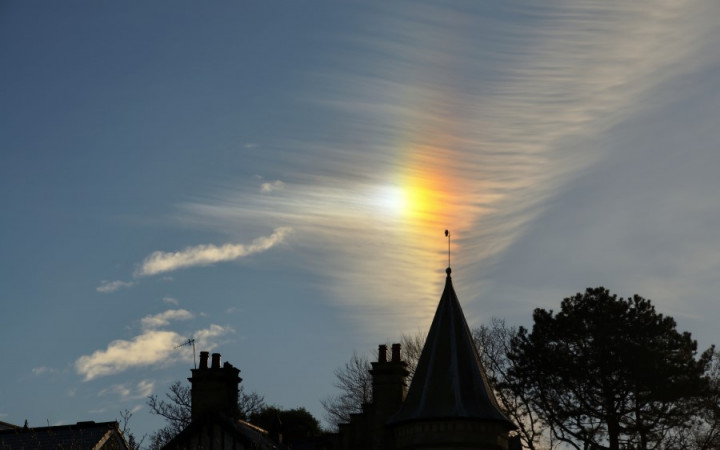
Today’s Wonder of the Day was inspired by Rhonda . Rhonda Wonders, “What is a sun dog?” Thanks for WONDERing with us, Rhonda !
What's that bright orb up in the sky? Yes, it's probably the Sun. But if it has been cloudy for days on end, especially during a rainy spring, the sudden appearance of the Sun can seem like a celestial mystery.
Even more mysterious is the appearance of bright, colorful patches of light on each side of the Sun. If you've ever seen this curious phenomenon, you may have been WONDERing if you were seeing double or even triple. No need to get your eyes checked, though, you were probably just seeing sun dogs.
Sun dogs don't bark, and they don't wag their tails. They also won't eat your homework. What they will do, however, is amaze onlookers and get people pointing up at the sky.
Bright, colored areas of light beside the Sun are known as sun dogs (sometimes written as one word: sundogs). They're often approximately 22 degrees to the left or the right (or both!) and about the same distance above the horizon as the Sun. They're also often seen as part of a ring or halo around the Sun.
Sun dogs are known as parhelia (singular: parhelion) in the scientific community, which comes from the Greek words meaning "beside the Sun." Other common names for sun dogs include mock or phantom suns.
Sun dogs form when there are hexagonal ice crystals in high, cold cirrus clouds. They can also form when ice crystals float in the air during extremely cold weather. Although sun dogs are more common when cold weather brings ice crystals into the atmosphere, they can occur anywhere in the world any time there are cirrus clouds.
Ice crystals in the air act like prisms, bending the Sun's rays and refracting them in such a way that sun dogs appear. Because of the way that the Sun's light gets bent, sun dogs will often appear red on the side closest to the Sun with a blue or white tail stretching horizontally away from the Sun.
Scientists don't know how the term "sun dog" originated. Historians do know that the term has been around in art and literature for well over a century. Some experts believe the term may have arisen by way of comparing how parhelia follow the Sun to the way a dog follows its master.
The sun dog phenomenon can also occur at night when the Moon is nearly full and particularly bright. These moon dogs, or paraselenae, aren't seen nearly as often as sun dogs, because the conditions necessary for their formation don't happen very frequently.
Check out the Sun Dog and Moon Dog Gallery


