Showing posts with label food history. Show all posts

Friday, December 17, 2021

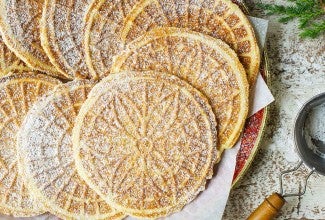
Pizzells, My Mom's recipie, some history, and a ramble

Firstly, a few clips from various "Googles"  about pizzelles


Pizzelle (Italian pronunciation: [pitˈtsɛlle], singular pizzella) are traditional Italian waffle cookies made from flour, eggs, sugar, butter or vegetable oil, and flavoring (usually anise or anisette, less commonly vanilla or lemon zest).

Pizzelles are the oldest known cookie and originated in the mid-section of Italy. They were made many years ago for the “Festival of the Snakes” also known as the “Feast Day of San Domenico” in the village of Colcullo in the Italian region of Abruzzo.Nov 30, 2020
 
Pizzelle originated centuries ago in the Abruzzo region of south-central Italy, according to 19th-century Italian historian Giuseppe Tassini, and are still common in the neighboring regions of Molise (formerly part of Abruzzo) and Lazio, home of Rome.
 
 
According to history, the first pizzelle cookies were made in the region of Abruzzo (geographically located in Central Italy) back in the 8th century. These highly recognizable Italian cookies get their shape by flattening the batter between two hot iron plates (just like waffles).Mar 6, 2021


Thursday, December 16, 2021

guest blogger Livia Gershon from The Smithsonian~~~sweet Treats from Stonehenge

Stonehenge's Builders May Have Feasted on Sweet Treats

Livia Gershon

small pies cooking on hot stone by fire
Neolithic people may have cooked predecessors of modern mince pies on stones heated in a fire's embers. Andre Pattenden / English Heritage

Travelers visiting Stonehenge this month can sample a dish that may have been enjoyed by the monument’s builders some 4,500 years ago. As Alex Green reports for PA Media, volunteers with English Heritage, the organization that cares for the prehistoric site, are cooking up mince pies with ingredients used by these Neolithic workers, including hazelnuts and crab apples.

Excavations at Durrington Walls, a settlement where Stonehenge’s creators lived around 2500 B.C.E., have previously yielded fruits and hazelnuts, as well as pork, beef and dairy products. No evidence suggests that the site’s inhabitants turned these foods into pies, but English Heritage notes that they presumably had all the necessary ingredients for the meal. People at the time grew cereal crops and may have used wheat, hazelnut or acorn flour to bake treats on flat stones or ceramic pots heated in a fire’s embers.

“Adding meat fats to hazelnuts and fruit would have made a great energy bar, full of calories,” says Susan Greaney, senior properties historian at English Heritage, in a statement.

Much like today, Neolithic people didn’t appreciate food purely for its nutritional value. Seasonal feasts may have represented celebrations and opportunities for community bonding, particularly with those traveling from a great distance to participate in the enormous Stonehenge building project.

“We’ll never know for certain what recipes they favored, but it’s fun to imagine travelers being greeted with a tray of mince pies,” Greaney says.

Stonehenge's Builders May Have Feasted on Sweet Treats
Volunteers at Stonehenge are baking the "Neolithic-inspired mince pies" every Monday in December. Andre Pattenden / English Heritage

Research shows that the winter solstice was a key time for the individuals who lived and worked at Stonehenge. Visitors from as far away as Scotland traveled to the monument, bringing cows and pigs for feasts, reports Steven Morris for the Guardian. 

The Stonehenge Riverside Project, a collaborative effort by academics at five universities in the United Kingdom, found evidence of fruit- and nut-gathering at Durrington Walls, which stands 1.5 miles northeast of Stonehenge itself. Trash heaps near ancient homes contained the remains of hazelnuts, crab apples and sloes (also known as blackthorns, the berries are used to make sloe gin). 

Stonehenge was built in several stages, with the earliest henge monument at the site constructed around 3000 B.C.E. The iconic stone circle seen today was erected around 500 years later. Building activity continued in the area for hundreds of years.

Much of the evidence about these workers’ eating habits comes from the settlement at Durrington Walls, which housed hundreds of prehistoric people during a relatively short period of 50 to 100 years, as Morris wrote for the Guardian in 2017.

Per BBC News, volunteers will bake pies inspired by the discoveries around the hearth in Stonehenge’s Neolithic Houses every Monday in December. For those unable to make it to Wiltshire, English Heritage offers two recipes for Neolithic-inspired mince pies. One uses authentic Stone Age ingredients and open-fire cooking, while the other is adapted for modern kitchens. The Neolithic recipe calls for flour made from acorn and einkorn, the oldest known form of wheat, as well as lard, rose hips and fruit.


September full moon, haiku

  RAIN  GENTLY FALLING waiting FOR THE CLOUDS TO CLEAR  THERE YOU ARE, LADYMOON!!!