Years, many many years ago when most people had black and white only TVs, there was a educational program on a 3:30 Pm, aha! just when one got home from school. "An educational program", you could call it a travel log......and it really was informative. Aimed at {I think} gradeschool kids and stressing customs and everyday life. One day it featured The Isle of man....and so it goes. Always wanted to see Hop Tu Naa....in person.
- Main Festival Date: Saturday, October 31, 2026 [1]
- Location: Cregneash Folk Village, Isle of Man [1]
- Festival Sessions: 10:00 AM – 12:00 PM or 1:00 PM – 3:00 PM [1]
- Activities: Turnip carving, traditional music, dancing, and the story of Jinny the Witch. [1]
What is Hop-tu-Naa and how do Manx people mark it?
 CULTURE VANNIN
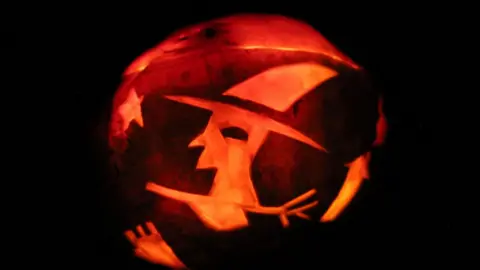
Manx people are preparing to mark Hop-tu-Naa by carving turnip lanterns and singing about Jinny the Witch.
The Celtic festival is the oldest unbroken tradition on the Isle of Man, and is celebrated on 31 October to mark the transition from summer to winter.
Although typically compared to Halloween, it is considered the Celtic New Year, as it celebrated the safe gathering of the harvest, and was a sign that preparations had been made for the coming winter.
James Franklin from Culture Vannin said the date marks the point where "the veil between this world and the other world is at its thinnest, making us open to outside influences like witches or fairies."
What does Hop-tu-Naa mean?
Hop-tu-Naa is a relatively modern name for the night in Manx Gaelic which has been adopted since the 1940s.
Before that, the holiday was referred to as Hop-tu-Naa night, and had previously been called the night for singing Hop-tu-Naa.
Mr Franklin said that while some believe it is just a sound that was adopted in the traditional song called Hop-tu-Naa, others believe that it could refer to the fairies, the trolls and the elves, linking the celebration to older Norse era beliefs.
What are the traditions?
 CULTURE VANNIN
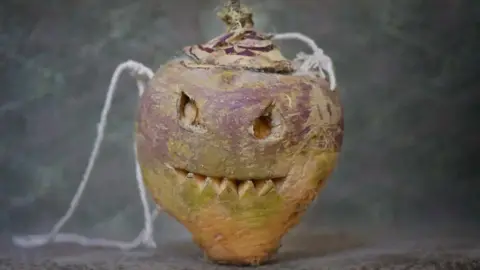
A key part of Hop-tu-Naa is turnip carving, in which the root vegetable is hollowed out, decorated and turned into a lantern.
These turnip lanterns are often taken around the community, a custom which Mr Franklin said could be linked to a belief that fire serves as "protection against evil" on Hop-tu-Naa night.
"The great thing about carving turnips is that you earn it by the end, because it is so much more difficult" than carving a pumpkin, he said, adding that the smell of a turnip lantern was "something special".
During the evening, children often go around houses singing traditional songs including Hop-tu-Naa, the tune of which varies across regions, as well as songs about the Manx folklore character Jinny the Witch.
Some fortune-telling rituals, which have not continued, saw young women bake and eat a "dumb cake" in silence during the evening, before walking backwards towards bed with their future husbands believed to appear in their dreams that night.
Many of these customs were believed to garner good luck for the coming winter and ward off evil spirits.
Who is Jinny the Witch?
Jinny the Witch has become an intrinsic figure in the tradition, referred to during either through song, or costume.
Tales of Jinny the Witch stem from Joney Lowney, a woman from Ballaglonney who lived about 300 years ago.
She had six children, and would go around and ask for money, but it was soon noted that bad luck would fall on those who had refused her.
However, she was also known to help people, by gathering herbs and making potions with them, often being asked by farmers to provide a cure for a sick animal.
Her notoriety grew on the island, as she was famed for her magic.
But one day she questioned the quality of sacks of flour being distributed to the poor by the Bishop's miller, and once she spoke, the mill machinery stopped, and could never be revived.
She was arrested and charged with practicing witchcraft, found guilty at trial, and spent 14 days at Peel Castle.
She was fined £3 and ordered to wear a white sheet and stand at the Market Cross of the four main towns, Castletown, Douglas, Ramsey and Peel holding a sign that said "for practices in sorcery and witchcraft".
What events are taking place?
A number of events will be taking place in the coming week to mark the festival:
- Hop-tu-Naa Festival at Cregneash: Taking place on Saturday, the event will see turnip carving, music, dancing and story-telling, which will run from 10:00 until 12:00 BST or from 13:00 until 15:00.
- Great Laxey Mine Ghost Trains: Running on Saturday and Sunday
- Laxey Hop-tu-Naa Trail: Running until 2 November, free trail maps can be picked up from the Winn Boutique, the Co-op, the Commissioners' Office, the Beach Stop Cafe, or The Shed
- The Enormous Turnip at Cregneash: Music and storytelling, taking place from 11:00 until 13:00.
- Turnip-carving at Cregneash: taking place from 10:00 until 16:00 on Monday to Friday, with an additional one-hour sessions held at the historical site on Wednesday at 10:00, 12:00, 13:30 or 15:00 for those under 5.
- Children's Hop-tu-Naa Dance Party: From 18:00 until 19:00 on Friday at Morton Hall in Castletown