The other day when i began to write this post, i wondered if i could find anything new to write about. Having written about the full moon for several years....yes it finally happened, it happened, i hit the wall, drew a blank, NO IDEAS.....zipnadda.....crickets!!!!!
Then i found this piece by "How stuff works". I was temped to shout my favorite, but colorful expletive. Instead i read this start to finish.
Thank you to the folks at ****** HOW THINGS WORK****, yup seriously worth reading, try it please, gentle readers. Filled with information.
IN the mean time i will be working on some new way to celebrate the new moon , each one of them, here, in this blog. And, yes i do know this piece was written in 2023.
Next full moon is the Sturgeon Moon peaks at Friday, August 28, 2026, at 12:18 am EDT
Why August's Moon Is Known as the Sturgeon Moon
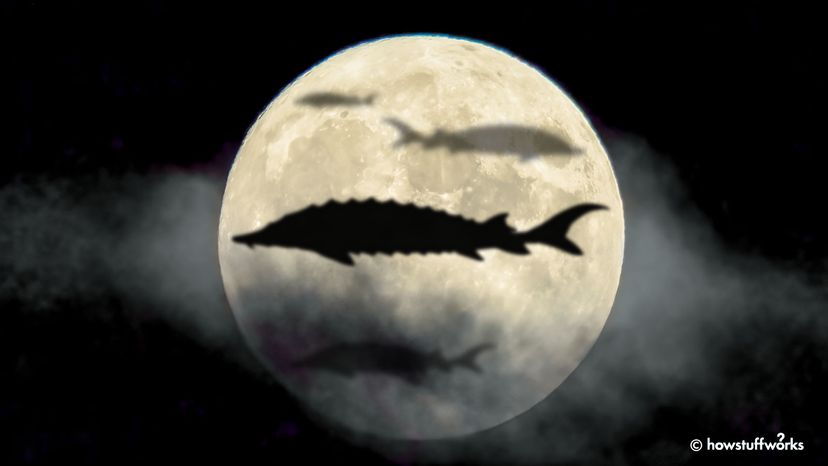
Mark your calendar for Aug. 1, 2023, to catch the most stunning of all moon phases: the full moon. More specifically, the sturgeon moon reaches peak illumination at 2:32 p.m. ET, according to the Old Farmer's Almanac. But don't worry; while the sturgeon moon rises relatively early, it will be visible in the night sky until approximately 5:11 a.m. ET on Aug. 3.
Catching the August Supermoon
This year, August's sturgeon moon is also a supermoon. A supermoon — which is not an official astronomical term — is a full moon that occurs when the moon's orbit brings it closer to Earth.
Because it's closer to Earth than normal, a supermoon appears larger and brighter than regular full moons, hence its name. Every year there are three to four supermoons, and they always occur consecutively.
The sturgeon supermoon is the second of four supermoons in 2023. This month in 2023 is chock-full of lunar events; on Aug. 30, there will be a blue supermoon! It will be the largest full moon of the year.
Naming the Sturgeon Moon
The terms "full moon" and "supermoon" are easy to understand, but what the heck is a sturgeon moon? Ancient peoples gave names to each full moon, typically selecting a moniker that matched something that regularly occurred that month or season.
Some say the nickname "sturgeon moon" is derived from the fact that Native Americans found it easiest to catch the sturgeon fish swimming around the Great Lakes region and Lake Champlain (home of Champy) during August. Others believe it comes from Algonquin tribes in the northeastern U.S. and Canada, who noticed more of the prehistoric-looking fish in the lakes at this time of the year.
The freshwater lake sturgeon was an essential food source for Native American tribes living in the Great Lakes and Lake Champlain regions. The oldest native fish species in the Great Lakes, the sturgeon first appeared in fossil records more than 200 million years ago. Sturgeon are also the largest native Great Lakes fish, stretching up to 9 feet long (2.7 meters) and tipping the scales at up to 275 pounds (125 kilograms).
More August Full Moon Names
While many people refer to August's full moon as the sturgeon moon, that is just one of its many nicknames. The Anishinaabe people, for example, called it the ricing moon, as August was the time to harvest their wild rice crops.
Another name is the green corn moon, given to August's full moon by Native American tribes such as the Cherokee and Creek. This name signifies the approaching ripeness of corn crops and holds cultural importance, representing a time of gratitude, communal celebrations, and spiritual renewal within these indigenous communities. Other common names include the grain moon and the red moon.
Some Northern Europeans referred to this full moon as the lightning moon, since there are frequent storms featuring thunder and lightning during late summer in their corner of the world. Another European term is corn moon, signifying the crop they were preparing to harvest.
Speaking of which, September's full moon will be the harvest moon! Every month has its own special full moon names.
Sturgeon Moon FAQ
Why is a Sturgeon Moon special?
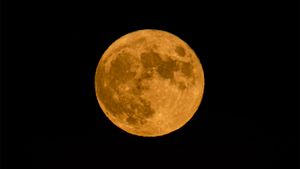
Why was the Sturgeon Moon red?
How long does a full moon last?
What does the Moon symbolize for the indigenous peoples?
How rare is a full supermoon?
What is the rarest moon in the world?
What is a wolf supermoon?
What is a snow moon?
What Is a strawberry moon?

Worm, Harvest, Blue: Every Full Moon Has a Name
By: Nathan Chandler
A full moon is an unmistakable celestial event that basks Earth with its lunar glow, inspiring songwriters, scientists, and the occasional werewolf rampage. Throughout human history, moon phases have signaled changes in seasons and marked important cultural transitions, such planting or hunting, all reasons that people took to inventing monikers for each full moon.
Ancient full moon names often originated from Native American tribes, and the names usually symbolized something about the weather conditions or nature at the time the moon was likely to appear. European settlers adopted those names and added some of their own. Periodicals like The Farmer's Almanac publicized the names for a wider audience. Other cultures had their own names for the moons as well.
Full moons occur about every 29.5 days. On those nights, the moon is a full disc shape, and on cloud-free nights it reflects full sunlight, illuminating the Earth below in a dreamlike glow. The second full moon in a month is usually known as a blue moon (see sidebar).
Full Moon Calendar 2023
Here's a list of some of the most common names for the full moon in the Northern Hemisphere, with alternate names in parentheses, along with the dates they appear in 2023.
Jan. 6: Wolf Moon (Old Moon, Moon After Yule)
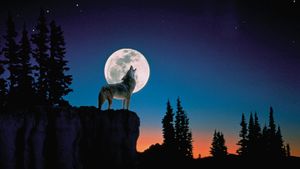
When January's icy grip clutches the land, hungry wolves roam in search of prey. Their lonely howls inspire the name of this moon.
Feb. 5: Snow Moon (Hunger Moon)
In North America, this is a snowy and frigid month. It's also a lean time when food is hard to find in the wild.
March 7: Worm Moon (Crow Moon, Sap Moon)
As February's deep freeze relents, March winds warm the land, and earthworms begin to awaken from their winter slumber.
April 6: Pink Moon (Egg Moon, Grass Moon)
Native Americans noted pink wildflowers emerging around the time of the April full moon. The flowers' hue gave rise to the moniker "pink moon."
May 5: Flower Moon (Milk Moon, Planting Moon)
April showers bring May flowers, so May is a time of lush revitalization across North America.
June 3: Strawberry Moon (Flower Moon, Rose Moon)
If you really love strawberries, you plant the June-bearing species. Then, as June's sunlight warms the land, your plants bear fruit under the full June moon.
July 3: Buck Moon (Thunder Moon, Hay Moon)
Every year, male deer begin growing their antlers anew around July. The buck moon marks this occasion.
Aug. 1: Sturgeon Moon (Grain Moon, Green Corn Moon)
In North America, sturgeon became more abundant and easier to catch in August, making this the sturgeon moon.
Aug. 30: This is a blue moon, an extra moon in the same month. This will be the biggest full moon of the year.
Sept. 29: Harvest Moon (Fruit Moon)
As summer fades, the weather turns cold and the days get shorter. The harvest moon is nigh.
Oct. 28: Hunter's Moon
After a summer of plenty, the game animals of North America are in peak condition. It's traditionally the best time for hunters to take to the field, stocking up on meat for the winter.
Nov. 27: Beaver Moon (Frosty Moon)
Beavers briskly prepare their dams for winter, and trappers step up their efforts to catch the chubby little guys in the act. It's the Beaver moon.
Dec. 26: Cold Moon (Full Long Nights Moon)
If you've ever been to North Dakota in December, this one requires no interpretation whatsoever.
What Are the 8 Phases of the Moon, in Order?
By: Valerie Stimac
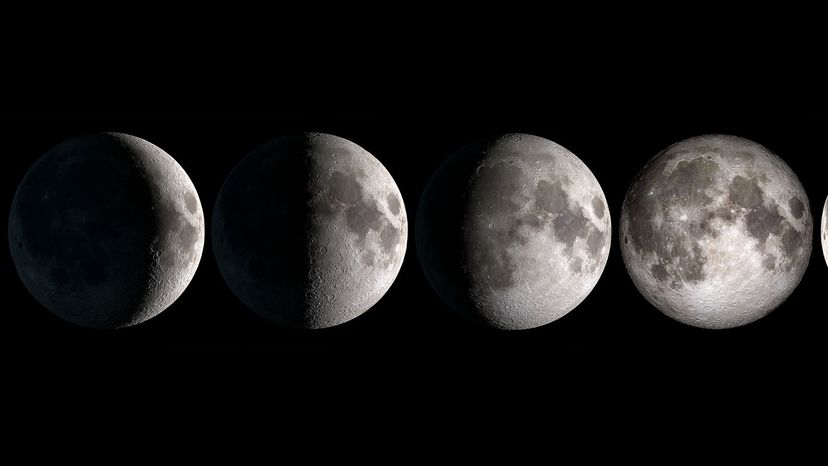
It's hard to imagine life on Earth without the moon overhead each night. Though the moon seems an omnipresent object in the night sky, it actually goes through a number of phases and has a unique set of steps in the celestial dance of our solar system.
If you've ever wondered why the moon looks different each night, rises at a different time, or what those strange names for the phases of the moon mean, the truth is out there. We'll explain the different moon phases and how the lunar cycle works — for our moon anyway (each moon is different on other planets!).
Why Does the Moon Have Phases?
As we know, Earth's orbit revolves around the sun and the moon orbits Earth. The moon is "tidally locked," meaning the moon is rotating on its own axis at the same rate it orbits Earth (unlike Earth, which rotates at a different rate than it orbits the sun, hence we have both days and years). The tidal lock means the same hemisphere of the moon is always pointing at or visible from Earth.
The moon doesn't produce any light of its own — it just reflects the sun. The sun shines on different parts of the moon, since the same part of the moon is always facing us. Sometimes, we can see part of the moon that is illuminated by the sun (or all, such as during a full moon), and other times we cannot (during a new moon). Each night, a different amount of the moon is illuminated, which creates different phases of the moon.
The Four Primary Moon Phases
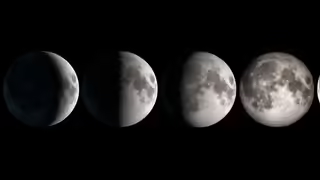
The moon has eight phases in each lunar cycle: four primary phases and four secondary phases. The four primary phases are:
- new moon
- first quarter
- full moon
- third quarter
These occur at a specific time each month, and you can check the exact time to see if the moon will be risen and visible in your location as it reaches that phase.
The Four Secondary Moon Phases
The four secondary moon phases are not at a specific time; they are transitions that the moon goes through between the primary phases. The moon may stay in one of these phases for seven days. They are:
- waxing crescent
- waxing gibbous
- waning gibbous
- waning crescent
For the most part, the names of the moon phases make sense, such as "waxing" when the illuminated part of the moon is growing and "waning" when the illuminated part is shrinking. The "crescent" moon is also a familiar concept, as the moon's shape is that of a crescent during this time. Perhaps the most novel term in the lunar calendar is "gibbous," which broadly means convex, but in astronomy specifically refers to the time when the moon is more than half but not wholly illuminated.
Let's look at an entire lunar cycle by going into detail about the lunar phases.

New Moon
If you've ever looked up at night and not seen the moon, it might be due to the fact that we're in the new moon phase. At the moment of the new moon, the side of the moon facing Earth is not being illuminated by the sun, so it appears black — though to our eyes, it's doesn't actually "appear" at all and is not visible at all against the blackness of space beyond.
Waxing Crescent Moon
The waning crescent phase of the lunar cycle occurs between the time of the new moon and when it reaches its first quarter phase. During this time, the moon appears as sliver in the night sky, growing more illuminated each night until half of it is lit (the first quarter phase). These first few days of the lunar cycle are also good for stargazing as the moon is still quite dim in the sky.
First Quarter Moon
The first quarter phase of the moon is so named because it occurs when the moon is one-quarter of the way through its 29.5-day cycle. If you can see the moon on this night, it will appear half illuminated and half dark. (If you look at the sky, you might say there is a half-moon out.) As the moon passes through its first quarter phase, it begins to interfere with stargazing prospects and most avid stargazers will either switch to examining the moon directly or take a break from stargazing until later in the lunar cycle when the moon is less illuminated.
Waxing Gibbous Moon
After passing through the first quarter phase, the moon continues to become more illuminated; in the waxing gibbous phase, it is not quite fully lit — but increasingly so. This phase takes about one week and offers great opportunities to use a telescope or binoculars to study the moon's terminator line where the light and dark parts of the moon meet.
Full Moon
The full moon phase occurs on the night when the hemisphere of the moon facing Earth is completely illuminated by the sun. Most of us are familiar with this sight and perhaps even drew the full moon with a face as a child. While there is no "man in the moon," there are a number of fascinating craters and mare (basaltic plains formed from volcanic activity in the moon's past) that look like various shapes on the moon's surface.
Waning Gibbous Moon
After passing through its full phase, the illuminated portion of the moon begins to decrease, which is the waning half of the lunar cycle. First, the waning gibbous phase occurs where the moon is not fully but still more than half illuminated.
Third Quarter Moon
The final primary phase in the lunar cycle is the third quarter moon, which the moon reaches at a specific time each month. At this time, the "other half" of the moon will be illuminated, compared to the first quarter phase. However, you may not see the exact third quarter moon every month as it may not be visible during the day depending on where you live.
How the Moon Works
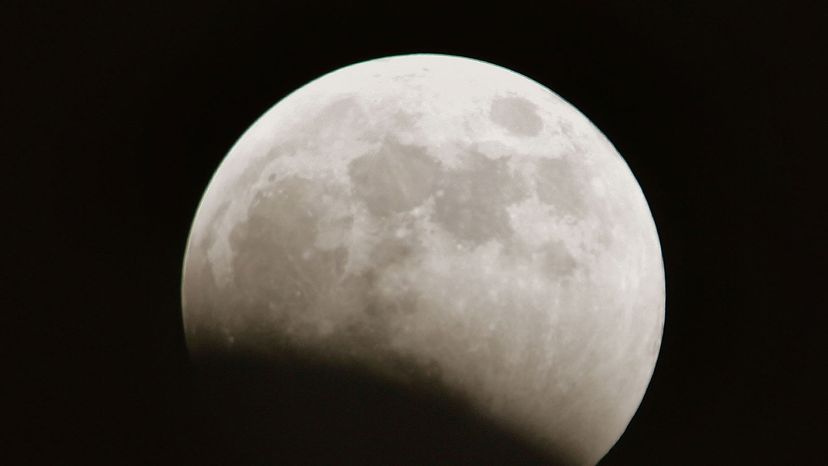
From anyplace on Earth, the clearest thing in the night sky is usually the moon, Earth's only natural satellite and the nearest celestial object (240,250 miles or 384,400 km away). Ancient cultures revered the moon. It represented gods and goddesses in various mythologies -- the ancient Greeks called it "Artemis" and "Selene," while the Romans referred to it as "Luna."
When early astronomers looked at the moon, they saw dark spots that they believed were seas (maria) and lighter regions that they believed was land (terrae). Aristotle's view, which was the accepted theory at the time, was that the moon was a perfect sphere and that the Earth was the center of the universe. When Galileo looked at the moon with a telescope, he saw a different image -- a rugged terrain of mountains and craters. He saw how its appearance changed during the month and how the mountains cast shadows that allowed him to calculate their height. Galileo concluded that the moon was much like Earth in that it had mountains, valleys and plains. His observations ultimately contributed to the rejection of Aristotle's ideas and the Earth-centered universe model.
Because the moon is so close to the Earth relative to other celestial objects, it's the only one to which humans have traveled and set foot upon. In the 1960s, the United States and Russia were involved in a massive "space race" to land men on the moon. Both countries sent unmanned probes to orbit the moon, photograph it and land on the surface. In July 1969, American astronauts Neil Armstrong and Edwin "Buzz" Aldrin became the first humans to walk on the moon. During six lunar landing missions from 1969 to 1972, a total of 12 American astronauts explored the lunar surface. They made observations, took photographs, set up scientific instruments and brought back 842 pounds (382 kilograms) of moon rocks and dust samples. What did we learn about the moon from these historic journeys?
Let's take a closer look at the moon. We'll examine its surface features and learn about its geology, internal structure, phases, formation and influence on the Earth.
What's On the Surface of the Moon?

As we mentioned, the first thing that you'll notice when you look at the moon's surface are the dark and light areas. The dark areas are called maria. There are several prominent maria.
- Mare Tranquilitatis (Sea of Tranquility): where the first astronauts landed
- Mare Imbrium (Sea of Showers): the largest mare (700 miles or 1100 kilometers in diameter)
- Mare Serenitatis (Sea of Serenity)
- Mare Nubium (Sea of Clouds)
- Mare Nectaris (Sea of Nectar)
- Oceanus Procellarum (Ocean of Storms)
The maria cover only 15 percent of the lunar surface.
The remainder of the lunar surface consists of the bright highlands, or terrae. Highlands are rough, mountainous, heavily cratered regions. The Apollo astronauts observed that the highlands are generally about 4 to 5 km (2.5 to 3 miles) above the average lunar surface elevation, while the maria are low-lying plains about 2 to 3 km (1.2 to 1.8 miles) below average elevation. These results were confirmed in the 1990s, when the orbiting Clementine probe extensively mapped the lunar surface.
The moon is littered with craters, which are formed when meteors hit its surface. They may have central peaks and terraced walls, and material from the impact (ejecta) can be thrown from the crater, forming rays that emanate from it. Craters come in many sizes, and you'll see that the highlands are more densely cratered than the maria.
Another type of impact structure is a multi-ringed basin. These structures were caused by huge impacts that sent shockwaves outward and pushed up mountain ranges. The Orientale Basin is an example of a multi-ringed basin.
Besides craters, geologists have noticed cinder cone volcanoes, rilles (channel-like depressions, probably from lava), lava tubes and old lava flows, which indicate that the moon was volcanically active at some point.
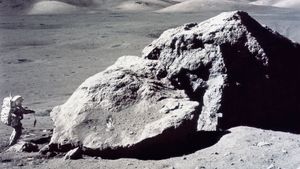
The moon has no true soil because it has no living matter in it. Instead, the "soil" is called regolith. Astronauts noted that the regolith was a fine powder of rock fragments and volcanic glass particles interspersed with larger rocks.
Upon examining the rocks brought back from the lunar surface, geologists found the following characteristics:
- The maria consisted primarily of basalt, an igneous rock derived from cooled lava.
- The highland regions include mostly igneous rocks called anorthosite and breccia
- If you compare the relative ages of the rocks, the highland areas are much older than the maria. (4 to 4.3 billion years old versus 3.1 to 3.8 billion years old).
- The lunar rocks have very little water and volatile compounds in them (as if they've been baked) and resemble those found in the Earth's mantle.
- The oxygen isotopes in moon rocks and the Earth are similar, which indicates that the moon and the Earth formed at about the same distance from the sun.
- The density of the moon (3.3 g/cm3) is less than that of the Earth (5.5 g/cm3), which indicates that it doesn't have a substantial iron core.
Astronauts placed other scientific packages on the moon to collect data:
- Seismometers didn't detect any moonquakes or other indications of plate tectonic activity (movements in the moon's crust)
- Magnetometers in orbiting spacecraft and probes didn't detect a significant magnetic field around the moon, which indicates that the moon doesn't have a substantial iron core or molten iron core like the Earth does.
Let's look at what all of this information tells us about the formation of the moon.
Giant Impactor Hypothesis

At the time of Project Apollo in the 1960s, there were basically three hypotheses about how the moon formed.
- Double planet (also called the condensation hypothesis): The moon and the Earth formed together at about the same time.
- Capture: The Earth's gravity captured the fully formed moon as it wandered by.
- Fission: The young Earth spun so rapidly on its axis that a blob of molten Earth spun off and formed the moon.
But based on the findings of Apollo and some scientific reasoning, none of these hypothesis worked very well.
- If the moon did form alongside the Earth, the composition of the two bodies should be about the same (they aren't).
- The Earth's gravity isn't sufficient to capture something the size of the moon and keep it in orbit.
- The Earth can't spin fast enough for a blob of material the size of the moon to just spin off.
The Giant Impact Theory
Because none of these hypotheses was satisfactory, scientists looked for another explanation.
In the mid-1970s, scientists proposed a new idea called the Giant Impactor (or Ejected Ring) hypothesis. According to this hypothesis, about 4.45 billion years ago, while the Earth was still forming, a large object (about the size of Mars) hit the Earth at an angle. The impact threw debris into space from the Earth's mantle region and overlying crust. The impactor itself melted and merged with the Earth's interior, and the hot debris coalesced to form the moon.
The Giant Impactor hypothesis explains why the moon rocks have a composition similar to the Earth's mantle, why the moon has no iron core (because the iron in the Earth's core and impactor's core remained on Earth), and why moon rocks seem to have been baked and have no volatile compounds. Computer simulations have shown that this hypothesis is feasible.
Geologic History of the Moon

Based on analyses of the rocks, crater densities and surface features, geologists came up with the following geologic history of the moon:
- After the impact (about 4.45 billion years ago), the newly formed moon had a huge magma ocean over a solid interior.
- As the magma cooled, iron and magnesium silicates crystallized and sank to the bottom. Plagioclase feldspar crystallized and floated up to form the anorthosite lunar crust.
- Later (about 4 billion years ago), magma rose and infiltrated the lunar crust, where they reacted chemically to form the basalt. The magma ocean continued to cool, forming the lithosphere (which is like the material in the Earth's mantle). As the moon lost heat, the asthenosphere (the next layer in) shrank toward the core and the lithosphere became very large. These events led to a model of the moon's interior that is very different from that of the Earth. Lunar Behavior The moon is thought to influence our daily life and moods, possibly even causing odd behavior. In fact, it's the inspiration for the word "lunatic." Werewolf aficionados, of course, know that a full moon triggers terrifying transformations. And hospital and emergency personnel tell of more crimes, accidents and births during a full moon -- but the evidence for this is mostly anecdotal rather than statistical.
- From about 4.6 to 3.9 billion years ago, the moon was intensely bombarded by meteors and other large objects. These impacts modified the lunar crust and gave rise to the large, densely cratered surface in the lunar highlands. Some of these bombardments produced large, multi-ringed basins and mountains.
- When the bombardment ceased, lava flowed from the inside of the moon through volcanoes and cracks in the crust. This lava filled the maria and cooled to become the mare basalts. This period of lunar volcanism lasted from about 3.7 billion years to 2.5 billion years ago. Much of the moon's heat was lost during this period. (Because the moon's crust is slightly thinner on the side that faces the Earth, lava could erupt more easily to fill the maria basins. This explains why there are more maria on the near side of the moon compared to the far side.)
- Once the volcanic period ended, most of the moon's internal heat was gone, so there was no major geologic activity -- meteor impacts have been the only major geologic factor at work on the moon. These impacts have not been as intense as in earlier periods of the moon's history; bombardments have generally been declining throughout the solar system. However, the meteoric bombardment that continues today has produced some large craters on the maria (like Tycho and Copernicus) and the fine regolith (soil) that covers the lunar surface.
Let's look at some of the phenomena involving the moon's orbit.
Moon Phases

Every night, the moon shows a different face in the night sky. On some nights we can see its entire face, sometimes it's partial, and on others it isn't visible at all. These phases of the moon aren't random — they change throughout the month in a regular and predictable way.
As the moon travels in its 29-day orbit, its position changes daily. Sometimes it's between the Earth and the sun and sometimes it's behind us. So a different section of the moon's face is lit up by the sun, causing it to show different phases.
Over the billions of years of the moon's existence, it has moved farther away from the Earth, and its rate of rotation has also slowed. The moon is tidally locked with the Earth, which means that the Earth's gravity "drags" the moon to rotate on its axis. This is why the moon rotates only once per month and why the same side of the moon always faces the Earth.
The moon has eight phases in each lunar cycle: four primary phases and four secondary phases. The four primary phases are:
- new moon
- first quarter
- full moon
- third quarter
These occur at a specific time each month, and you can check the exact time to see if the moon will be risen and visible in your location as it reaches that phase.
The four secondary phases are not at a specific time; they are transitions that the moon goes through between the primary phases. For instance, the moon may stay in one of these phases for seven days. They are:
- waxing crescent
- waxing gibbous
- waning gibbous
- waning crescent
"Waxing" means the illuminated part of the moon is growing and "waning" means the illuminated part is shrinking. The "crescent" moon is also a familiar concept, as the moon appears in the shape of a crescent during this time. Perhaps the most novel term in the lunar calendar is "gibbous," which broadly means convex, but in astronomy specifically refers to the time when the moon is more than half but not wholly illuminated.
The eight phases in order are: new moon, waxing crescent, first quarter, waxing gibbous, full moon, waning gibbous, third quarter and waning crescent. For more details, see our article on moon phases.
Tides
Every day, the Earth experiences tides, or changes in the level of its oceans. They're caused by the pull of the moon's gravity. There are two high tides and two low tides every day, each lasting about six hours.

The moon's gravitational force pulls on water in the oceans and stretches the water out to form tidal bulges in the ocean on the sides of the planet that are in line with the moon. The moon pulls water on the side nearest it, which causes a bulge toward the moon. The moon pulls on the Earth slightly, which drags the Earth away from the water on the opposite side, making another tidal bulge there. So, the areas of the Earth under the bulge experience high tide, while the areas on the thin sides have low tide. As the Earth rotates underneath the elongated bulges, this creates high and low tides about 12 hours apart.
The moon also stabilizes the Earth's rotation. As the Earth spins on its axis, it wobbles. The moon's gravitational effect limits the Chandler wobble to a small degree. If we had no moon, the Earth might move almost 90 degrees off its axis, with the same motion that a spinning top has as it slows down.
Return to the Moon
Since 1972, no one has set foot on the moon. However, there is a renewed effort for a lunar return. Why? In 1994, the orbiting Clementine probe detected radio reflections from shadowed craters at the moon's South Pole. The reflections were consistent with the presence of ice. Later, the orbiting Lunar Prospector probe detected hydrogen-rich signals form the same area, possibly hydrogen from ice.
Where could water on the moon have come from? It was probably carried to the moon by the comets, asteroids and meteors that have impacted the moon over its long history. Water was never detected by the Apollo astronauts because they didn't explore that region of the moon. If there is indeed water on the moon, it could be used to support a lunar base. The water could be split by electrolysis into hydrogen and oxygen -- the oxygen could be used to support life and both gases could be used for rocket fuel. So, a lunar base could be a staging point for future exploration of the solar system (Mars and beyond). Plus, because of the moon's lower gravity, it is cheaper and easier to lift a rocket off of its surface than from Earth.
It might tricky to get back there though, at least for U.S. astronauts. In 2010, President Barack Obama decided to cancel the Constellation program, the intent of which was to get Americans back on the moon by 2020. That means U.S. astronauts may have to hitch a ride with private space companies, which will receive some funding from NASA.
In September 2022, NASA attempted to launch megarocket Artemis 1 on the first mission to the moon since 1972, but technical difficulties have put this on hold for now.
Why July's Full Moon Is Known as the Buck Moon
By: Valerie Stimac
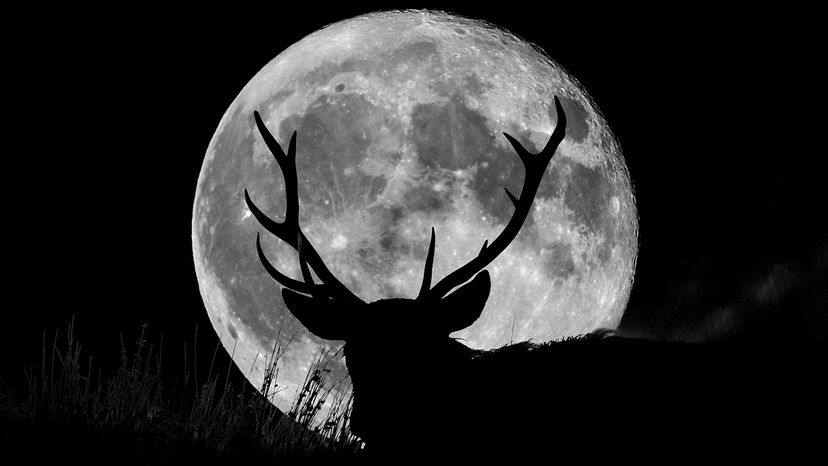
Though its pattern is completely predictable, there always seems to be something interesting happening with the moon and the phases of the moon, including the upcoming full moon in July.
You may have heard it called a "buck moon," and wonder why each full moon has a nickname – and where that moon name comes from. Here are some fascinating facts about the buck moon and when you can see it in the night sky.
In July 2022, the full moon will appear at 6:38 p.m. GMT (or 2:38 p.m. EDT) on July 13, according to NASA. For some people, mostly those in the Western Hemisphere and Far Eastern Hemisphere, this means the exact arrival of the full moon occurs during the daytime when the sun is in the sky and the moon is below the horizon. Don't worry though: The moon will still be brightly visible in the night sky once the sun goes down.
The Buck Moon Has Many Names
So, what are the origins of the term "buck moon" to describe the full moon in July? This refers to the new antlers that are growing rapidly on male deer (bucks) around this time. As deer lose their antlers each year, each part of the antler's growth – including when they reached full size in the mid-summer – was a notable part of the annual cycle. The term "buck moon" comes from the Native American Algonquin people, who primarily lived east of the Mississippi River where deer were prevalent.
Buck moon is not the only name you can give to July's full moon; other Native American groups call it the thunder moon, the berry moon, raspberry moon, and the salmon moon (a Tlingit term referring to the time when salmon return to the waterways of the Pacific Northwest). Celtic groups referred to it as the claiming moon, herb moon, wyrt moon ("wyrt" is another word for "herb") or mead moon.
The Brightest "Supermoon" of 2022
After several years of making headlines, you've probably heard the term "supermoon." The moon is considered a supermoon when it reaches its full phase near its perigee – that is, when it's at its closest point to Earth. This means there are a few supermoons, usually three to four, throughout the year. Supermoons are usually a bit brighter and a bit larger than "regular" moons, though most casual viewers can't perceive a difference.
The July 2022 buck moon is special because it's the brightest and biggest supermoon of 2022. June's strawberry moon was also considered a supermoon, but in July, the moon will be slightly closer and thus slightly bigger than last month. To be specific, the moon will be 222,089.3 miles (357,418 kilometers) from Earth – 124 miles (200 kilometers) closer than it was in June.
Every Lunar Cycle Has Other Names
In addition to calling the July full moon a buck moon, each of the other lunar cycles has many other names that have been passed down through history. Upcoming months reveal the changing seasons as summer slips into autumn. August is usually called the sturgeon moon, September is called the full corn moon and October is the hunter's moon. Each of these names usually refers to the status of agriculture or hunting at that time of year and helped mark the passage of time for Native American groups in the Americas pre-contact with European settlers.
22 Astronomical Events to Look Out for in 2023
By: Martha Sandoval
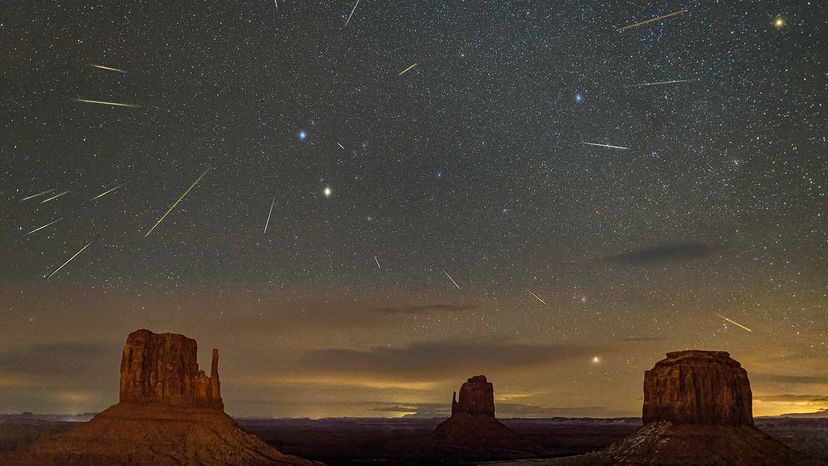
Thanks to the James Webb Space Telescope, we saw the first high-definition photos of outer space in 2022. Stunning images of galaxies, constellations, nebulae, black holes and much more were captured by the successor to the Hubble.
While we've been blown away by the sharpness of the pictures Webb has taken so far, nothing compares to gazing directly at the stars and other astronomical occurrences with our bare eyes.
As Earth transits a new orbital journey around the sun, there will be many opportunities to enjoy celestial shows. Using various news and scientific sources, we've compiled a list of 22 astronomical events you can see this year. Among them are 11 meteor showers, two eclipses and four supermoons. Most of them will be visible from North America sometime between dusk and dawn on the dates indicated.
- Mercury at Greatest Western Elongation, Jan. 30, May 29 and Sep. 22
- Mercury at Greatest Eastern Elongation, April 11, Aug. 10 and Dec. 4
- Hybrid Solar Eclipse, April 20
- Lyrid Meteor Shower, April 22-23
- Eta Aquarids Meteor shower, May 6-7
- Venus at Greatest Eastern Elongation, June 4
- Supermoons, July 3, Aug. 1, Aug. 31 and Sep. 29
- Delta Aquarids Meteor Shower, July 28-29
- Perseid Meteor Shower, Aug. 12-13
- Saturn at Opposition, Aug. 27
- Blue Moon, Aug. 31
- Neptune at Opposition, Sep. 19
- Draconid Meteor Shower, Oct. 7
- Annular Solar Eclipse, Oct. 14
- Orionids Meteor Shower, Oct. 21-22
- Venus at Greatest Western Elongation, Oct. 23
- Jupiter at Opposition, Nov. 3
- Taurids Meteor Shower, Nov. 4-5
- Uranus at Opposition, Nov. 13
- Leonid Meteor Shower, Nov. 17-18
- Geminid Meteor Shower, Dec. 13-14
- Ursids Meteor Shower, Dec. 21-22
Mercury at Greatest Western Elongation, Jan. 30, May 29 and Sep. 22
The planets closest to the sun are the most difficult to view. Look for Mercury on the days when its elliptical orbit takes it either closer or farther away from sunrise — hence at its greatest elongations. When it appears on the west side of the sun, it can be viewed at dawn as a shiny yellow dot.
Mercury at Greatest Eastern Elongation, April 11, Aug. 10 and Dec. 4

When positioned at its greatest eastern elongation, Mercury is closer to Earth and at its furthest angular point away from the sun. Though it's unlikely to be detected by the naked eye, it might be found with a ground telescope right before dusk.
Hybrid Solar Eclipse, April 20
The last time Earth's inhabitants could see a hybrid solar eclipse was Nov. 3, 2013. This rare eclipse changes appearance as the moon's shadow moves across the Earth's surface. The eclipse goes from annular to total for a brief period to finally become annular again.
Lyrid Meteor Shower, April 22-23

Comet Thatcher, discovered in 1861, is responsible for the Lyrid meteor shower that occurs every spring. In 2023, moonlight won't interfere with the views; stargazers in the Northern Hemisphere will be able to see about 10 to 15 meteors per hour when the Lyrid shower peaks.
Eta Aquarids Meteor shower, May 6-7
The Northern Hemisphere has another advantage: seeing the Eta Aquarids shower. These meteors are known to be swift; as a result, they leave behind glowing trails of incandescent debris that can last several seconds or even a few minutes. May 6 and 7 around midnight will be peak viewing time.
Venus at Greatest Eastern Elongation, June 4

The hottest planet in the solar system is also the brightest when detectable from Earth, consequently earning the name of morning or evening star. The first time in 2023 when Venus will be clearly visible is at its greatest eastern elongation. Look for it when it sets in the west immediately after the sun.
Supermoons, July 3, Aug. 1, Aug. 31 and Sep. 29

When a full moon occurs near or on its perigee — meaning when it's closest to Earth — it is called a supermoon. In 2023, we'll have several, including (chronologically) the full buck, full sturgeon, full blue and full harvest moons.
Delta Aquarids Meteor Shower, July 28-29
Since the Delta Aquarids are best noticed from the Southern Hemisphere, sky watchers in high northern latitudes tend to disregard them. However, in the southernmost parts of the United States, you can see 15 to 20 meteors in ideal conditions — that is with a dark sky and no moon.
Perseid Meteor Shower, Aug. 12-13
The Perseid is the most popular meteor shower of the year. If you're lucky, you can see anywhere between 50 and 100 dramatic meteors and fireballs per hour during its peak in midsummer. In Greek mythology, these showers are thought to be Zeus himself disguised as golden stars to seduce a beautiful mortal named Danaë, mother of Perseus.
Saturn at Opposition, Aug. 27

Planetary opposition occurs when a planet's orbit brings it between the sun and another planet. In this case, Saturn will reach opposition when it is opposite the sun in the sky. Planetary oppositions happen approximately once a year between Earth and those planets outside its orbit — Jupiter, Saturn, Uranus and Neptune. At the same time Saturn is at opposition, it will be closest to Earth — at perigee — making it appear brighter and larger in the sky and ideal for viewing.
Blue Moon, Aug. 31
A blue moon isn't really blue; it's just a second full moon in a calendar month. Since there are about 29.5 days between full moons it is an unusual but not-so-rare phenomenon. Blue moons happen every two-and-a-half years in any given month, but never in February.
Neptune at Opposition, Sep. 19
Neptune at opposition means it will be lined up with the sun and Earth. This means that it will rise when the sun sets, and set around the time the sun rises. It also will be at perigee — the closest to Earth — but that won't make it possible to distinguish among the stars without a telescope.
Draconid Meteor Shower, Oct. 7
The small comet called 21P/Giacobini-Zinner, which takes about 6.6 years to orbit the sun, is responsible for the Draconid meteor shower. Every time the comet returns to the inner solar system, its nucleus sprays rock and ice into space, causing the phenomenon. Sadly, most years the shower is too weak to be noticed, but under ideal conditions (a dark sky with no moon) you might see 10 Draconid meteors per hour if you're lucky.
Annular Solar Eclipse, Oct. 14

Millions of people at all latitudes of the Western Hemisphere will have a chance to witness one of Earth's most mesmerizing spectacles: an annular solar eclipse. That's the type of solar eclipse where only the outer edge of the sun remains visible because the moon is smaller than the sun. The path will track across the U.S. from Oregon to Texas to Central and South America then ends shortly after sunset in the Atlantic Ocean.
Orionids Meteor Shower, Oct. 21-22
Find an area far from light pollution and prepare to see one of the best annual meteor showers. The Orionid meteors are fast, luminous, and appear under some of the brightest stars, including the constellations Orion, Taurus and Gemini, staging quite a show.
Venus at Greatest Western Elongation, Oct. 23
Venus orbits nearer to the sun than Earth, making it disappear into the star's glare most of the time. Despite this, during its greatest elongation, it becomes the third-brightest object in the sky after the sun and moon. When it lies to the east, it will be in plain sight in the early evening twilight of Oct. 23.
Jupiter at Opposition, Nov. 3

Only the planets beyond Earth's orbit can be in opposition. One of them is the giant planet named after the king of ancient Roman gods. During the time when Earth lies directly between the sun and Jupiter, the latter will glow above the horizon during most of the night.
Taurids Meteor Shower, Nov. 4-5
The Taurids are known for their long-lasting meteors associated with comet Encke. These meteors are slow and can shine as bright — or brighter — than Venus. A shower formed by fireballs exhibits larger explosions of color and light that last longer than the train left behind by average meteor streaks.
Uranus at Opposition, Nov. 13
The striking blue planet will irradiate sunlight in mid-November when it aligns with the sun and Earth. When Uranus reaches opposition, it can be spotted at its brightest in the constellation Aries at midnight. Even so, it can be challenging to locate. Your chances are better if you use binoculars or a small telescope.
Leonid Meteor Shower, Nov. 17-18

To catch a glimpse of the Leonid meteor shower, find an area away from city lights, be prepared for the low temperatures of mid-autumn, lie down, turn your feet toward the east, look up, locate the Leo constellation and wait patiently. As soon as your eyes adapt to the dark, you'll be watching the Leonids meteor shower.
Geminid Meteor Shower, Dec. 13-14
An asteroid known as 3200 Phaethon is responsible for the Geminid meteor shower. This differs from most meteor showers, which result from comets, not asteroids. The first Geminid meteor shower appeared in the mid-1800s. This year there's a new moon Dec. 12, so that means a dark sky—ideal conditions for viewing. You could see as many as 120 Geminid meteors per hour.
Ursids Meteor Shower, Dec. 21-22
This low-key meteor shower is often overlooked, possibly because it peaks around the height of the holiday season. Its hourly rate of meteors is much lower than the Geminids, but in rare instances, some sky gazers are awarded with bursts of 100 or more meteors per hour.
How Supermoons Work
By: Patrick J. Kiger
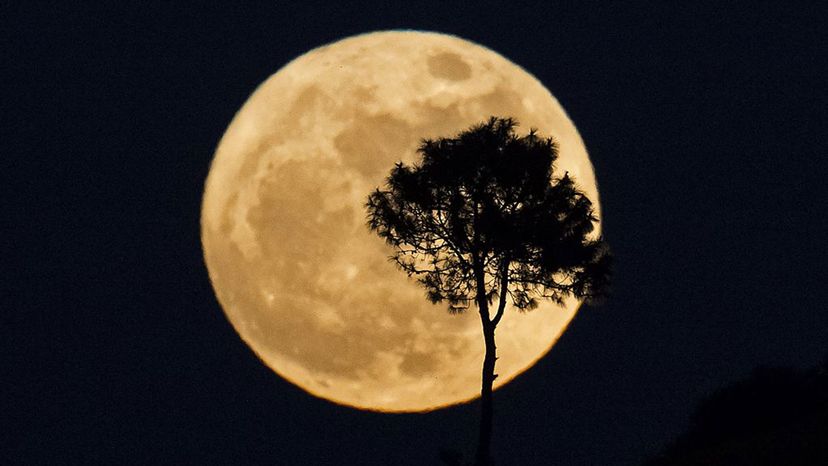
Every now and then, you'll hear about the imminent arrival of a supermoon and how it's going to be really amazing to see because it's going to be so huge and so close.
And if you do gaze into the night sky that evening, it actually can be a pretty cool sight. The term supermoons isn't one used by astronomers, but people use it to refer to a full or new moon that is near the closest point of its orbit around Earth. Depending on the exact distance between Earth and the moon that evening, a supermoon can be as much as 14 percent bigger and 30 percent brighter than the usual moon [source: Mathewson].
Supermoons have become a popular sensation in recent years, with scores of people posting snapshots of them on social media. Some stargazers stage supermoon viewing parties on rooftops, or travel to special locations — such as the mountains or the beach — to get a more spectacular view. Others put together playlists of songs to listen to while gazing at supermoons, such as Sting's "Moon Over Bourbon Street" or Cat Stevens' "Moonshadow" [source: Fernandez].
Supermoon mania may have reached its peak intensity on Nov. 13, 2016. That's when the satellite was 221,524 miles (356,508 kilometers) from Earth, the closest supermoon occurrence since Jan. 26, 1948, when it was 30 miles (48 kilometers) closer. (The average moon distance is 238,900 miles or 384,472 kilometers from Earth) [source: Netburn].
So what's all the fascination about? What actually causes a supermoon, and is it as rare as a blue moon? What sort of effects does it have upon the earth?
What Causes a Supermoon?

As we mentioned previously, "supermoon" isn't a scientific term. By several accounts, it was first coined back in the late 1970s by an astrologer, Richard Nolle, who defined it as a new or full moon that occurs when the moon is within 90 percent of its closest approach to Earth in a given orbit — 224,641 miles or 361,524 kilometers from the planet [source: King].
That definition, as astronomers point out, is a pretty easy one to fit. For all the hype that surrounds them, supermoons actually aren't all that rare, occurring between four and six times each year [source: McClure and Byrd].
Supermoons happen because the moon doesn't orbit the earth in a perfect circle, but rather in an elliptical path. That means the moon's distance from the Earth can vary in the course of a month, from 252,000 miles at its farthest point, which is called the apogee, to roughly 225,800 miles at its closest approach, which is called the perigee [source: King].
But the moon's orbit isn't perfectly regular, either, because it's affected by the sun's gravity. So on some occasions, the moon's perigee is closer than others [source: Astropixels.com]
Perigees happen on average every 29.53 days [source:McClure and Byrd].
But a few times a year, the sun, moon and Earth line up just right, so that a perigee coincides with the most dramatic phases of the moon — the new moon, when the orb is just a sliver — or the full moon. That's when we notice because the moon can appear to be slightly bigger and significantly brighter than normal [source: King].
There are four full supermoons in 2023: one in July (the buck moon), two in August (the sturgeon moon, and making for a blue supermoon!) and one in September (the harvest moon).
That said, the distinction between a full supermoon (what astronomers call a lunar perigee) and a normal full moon isn't so great that it's obvious to everyone, especially if you're not a regular gazer at the skies. If you want to make the difference clearer, astronomy writer Bob King suggests fashioning a homemade measuring device that he calls a "supermoon sighter."
Take a pair of scissors, and cut a series of slots of varying widths in an index card. Then hold the card parallel to your face and at arms' length while looking at the moon with one eye, and pick the slot into which the moon fits most snugly. Mark the date next to it. Then, when you hear the announcement of the next supermoon, repeat the procedure, and you should be able to see the difference.
Moonageddon or Myth? Supermoon Misconceptions

Since the idea of supermoons was dreamed up by an astrologer, it's not surprising that phenomenon is seen by some as a sign of future events, and perhaps even as a cause of them — a "Moonageddon," as one Australian news website put it.
If you poke around the internet, you'll find seers linking supermoons to earthquakes, volcanic eruptions, monster storms and even wildfires, and noting that various high-profile natural disasters occurred right around the time that a supermoon loomed over the nighttime landscape.
The makers of those claims often stretch the concept of proximity to extremes — 2005's Hurricane Katrina, for example, has been linked in some accounts to supermoon effects, even though it actually occurred more than seven months after a supermoon [source: Portman].
And even when a supermoon does occur close in time to a natural disaster — such as the 9.1 earthquake and tsunami that hit Japan eight days before a supermoon in March 2011 — that isn't necessarily evidence of a connection between two events.
As James Garvin, chief scientist at NASA's Goddard Space Flight Center, explained in a 2011 interview, the earth stores a tremendous amount of energy in its crust, and the relatively small amount of force exerted by the moon's gravitational pull isn't enough to alter the processes that cause earthquakes [source: NASA].
Supermoons don't have that much more effect on the earth than the moon usually does. The only exception is that when the moon is closer to the earth than usual, it does cause tides to be slightly higher — but only by slightly more than an inch, at most [sources: Sessions, ScienceDaily].
The belief that supermoons can affect human behavior is based upon the assumption that a supermoon, because the moon appears bigger than normal, exerts some sort of unusual force upon Earth's inhabitants. But there's no evidence that is so.
When it comes to gravity, for example, the effect of a full moon at perigee is only about three one-thousandths of an ounce (110 milligrams) greater than the moon exerts at apogee — 1/9 of the mass of a paper clip. That effect actually is smaller than you'll encounter when you're near a mountain or even a large building [source: Sessions].
How to Photograph a Supermoon

Even though supermoons don't really affect the earth much and aren't considered that important by scientists, they're still an interesting phenomenon to photograph. Here are some tips from photographers on shooting a supermoon.
- Use the right equipment and settings. Ideally, you want to use a digital single-lens reflex camera with an attachable 70 to 300 millimeter telephoto lens, so you can get a more detailed image. Use the daylight white balance setting on your DSLR, since what you're trying to capture is reflected sunlight.
- Turn off your flash, even if you're shooting with your smartphone. It'll illuminate your immediate surroundings, and make the moon look insignificant by comparison. Consider downloading one of the many apps that allow you to adjust a smartphone camera to take the best pictures in the darkness [sources: Gee, Orwig, Cuthbertson].
- Stabilize your camera. It's a good idea to use a tripod, or else to brace your camera against some fixed object such as a lamppost or windowsill, to reduce shaking that could wipe out details and make the image blurry. That also will allow you to use a longer exposure time and take in more light, a benefit when shooting at night [source: Hoffman].
- Don't just photograph the supermoon itself. NASA senior photographer Bill Ingalls recommends juxtaposing the moon with some land-based object, such as a recognizable local building, in order to give a reference point that will drive home the moon's size [source: Stone].
Worm, Harvest, Blue: Every Full Moon Has a Name
By: Nathan Chandler
A full moon is an unmistakable celestial event that basks Earth with its lunar glow, inspiring songwriters, scientists, and the occasional werewolf rampage. Throughout human history, moon phases have signaled changes in seasons and marked important cultural transitions, such planting or hunting, all reasons that people took to inventing monikers for each full moon.
Ancient full moon names often originated from Native American tribes, and the names usually symbolized something about the weather conditions or nature at the time the moon was likely to appear. European settlers adopted those names and added some of their own. Periodicals like The Farmer's Almanac publicized the names for a wider audience. Other cultures had their own names for the moons as well.
Full moons occur about every 29.5 days. On those nights, the moon is a full disc shape, and on cloud-free nights it reflects full sunlight, illuminating the Earth below in a dreamlike glow. The second full moon in a month is usually known as a blue moon (see sidebar).
Full Moon Calendar 2023
Here's a list of some of the most common names for the full moon in the Northern Hemisphere, with alternate names in parentheses, along with the dates they appear in 2023.
Jan. 6: Wolf Moon (Old Moon, Moon After Yule)
When January's icy grip clutches the land, hungry wolves roam in search of prey. Their lonely howls inspire the name of this moon.
Feb. 5: Snow Moon (Hunger Moon)
In North America, this is a snowy and frigid month. It's also a lean time when food is hard to find in the wild.
March 7: Worm Moon (Crow Moon, Sap Moon)
As February's deep freeze relents, March winds warm the land, and earthworms begin to awaken from their winter slumber.
April 6: Pink Moon (Egg Moon, Grass Moon)
Native Americans noted pink wildflowers emerging around the time of the April full moon. The flowers' hue gave rise to the moniker "pink moon."
May 5: Flower Moon (Milk Moon, Planting Moon)
April showers bring May flowers, so May is a time of lush revitalization across North America.
June 3: Strawberry Moon (Flower Moon, Rose Moon)
If you really love strawberries, you plant the June-bearing species. Then, as June's sunlight warms the land, your plants bear fruit under the full June moon.
July 3: Buck Moon (Thunder Moon, Hay Moon)
Every year, male deer begin growing their antlers anew around July. The buck moon marks this occasion.
Aug. 1: Sturgeon Moon (Grain Moon, Green Corn Moon)
In North America, sturgeon became more abundant and easier to catch in August, making this the sturgeon moon.
Aug. 30: This is a blue moon, an extra moon in the same month. This will be the biggest full moon of the year.
Sept. 29: Harvest Moon (Fruit Moon)
As summer fades, the weather turns cold and the days get shorter. The harvest moon is nigh.
Oct. 28: Hunter's Moon
After a summer of plenty, the game animals of North America are in peak condition. It's traditionally the best time for hunters to take to the field, stocking up on meat for the winter.
Nov. 27: Beaver Moon (Frosty Moon)
Beavers briskly prepare their dams for winter, and trappers step up their efforts to catch the chubby little guys in the act. It's the Beaver moon.
Dec. 26: Cold Moon (Full Long Nights Moon)
If you've ever been to North Dakota in December, this one requires no interpretation whatsoever.
What Is a Harvest Moon?
By: Nicole Antonio |
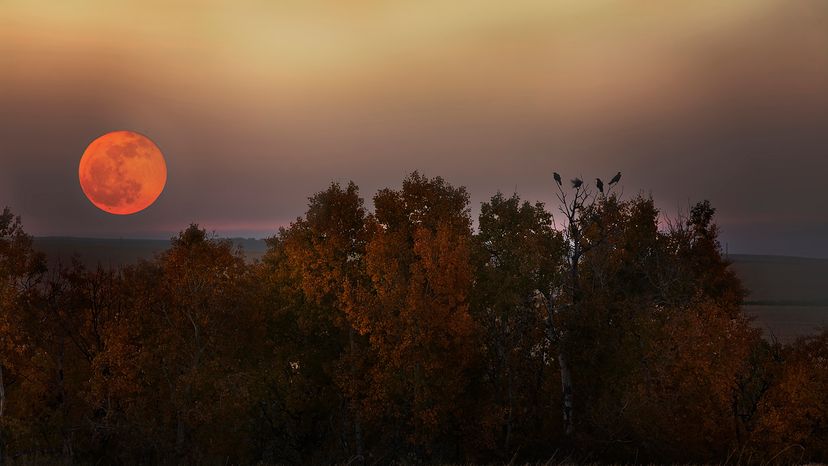
There are names for all the full moons that occur throughout the year (seriously, we collected all the full moon names in one place), but the harvest moon is a little bit different. It's based not on the month it falls within, but proximity to the autumnal equinox.
There are a few other curiosities about this particular full moon — especially in 2023, when the Northern Hemisphere will see the harvest moon overlap with the supermoon and a take on sunset-like hue. Read on to find out when to see this year's harvest moon and learn some fun (yet relevant!) pop culture trivia.
What Is a Full Harvest Moon?
The harvest moon is the full moon closest to the autumnal equinox, typically in late September or early October. Typically, the moon rises about 50 minutes later each day, but the same doesn't go for harvest moons. The rising harvest moon appears in the night sky about 25 minutes later than the previous night's moon — a much shorter time between moonrises.
This happens because of shallow angle between the moon's orbit and Earth's horizon, creating a quicker moonrise.
This phenomenon provides extra moonlight during evenings, which traditionally helped farmers gather crops late into the night and could give surfers better conditions to ride waves under the bright moonlight. The harvest moon is a practical ally, offering extended daylight-like hours for these activities during the transition from summer to fall.
When Is This Year's Harvest Moon?
According to Almanac, in Earth's Northern Hemisphere you can catch the 2023 harvest moon rising shortly after sunset on Thursday, Sept. 28, then reach peak illumination at 5:58 a.m. EDT on Friday, Sept. 29. This also marks the last supermoon of the year.
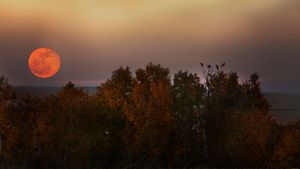
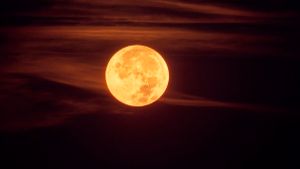
You may notice a red tint on the bright moon for the same reason you see the sun appears redder as it sets on the horizon: atmospheric scattering. As the sun (or moon) sinks lower, its light passes through more of Earth's atmosphere. This scatters shorter wavelengths in the visible spectrum — like blue and green — leaving the longer red wavelengths to reach our eyes.
Flipping the Script in the Southern Hemisphere
Our friends Down Under get a harvest moon in March or April, rather than September or October. Also, rather than the time shortening between the harvest moon and the previous night's moon, the time between actually gets longer.
Again, this is due to the angle between the moon and the horizon, but the tilt of Earth's axis means that this angle is wider in the Southern Hemisphere, rather than shallower as we see in the Northern Hemisphere.
September and the Corn Moon
The September full moon is sometimes called the corn moon or barley moon. These names derive from the time when the staple crops are ready for harvesting, signifying a period of abundance and preparation for the upcoming harvest season.
The corn moon is characterized by its slightly golden appearance in the night sky, reflecting the significance of corn in both modern farming communities and Native American cultures.
September's Full Moon in Pop Culture
Disney fans — 90s kids in particular — may remember the "blue corn moon" from the "Pocahontas" song "Colors of the Wind." This isn't a reference to blue corn (which is a real thing) but to a second full moon in September.
The second full moon in a calendar month is a blue moon, and September's full moon is the corn moon, hence the blue corn moon.
This article was created in conjunction with AI technology, then fact-checked and edited by a HowStuffWorks
