vv
| Written by Paul D. Race for Family Christmas OnlineTM |
|

|
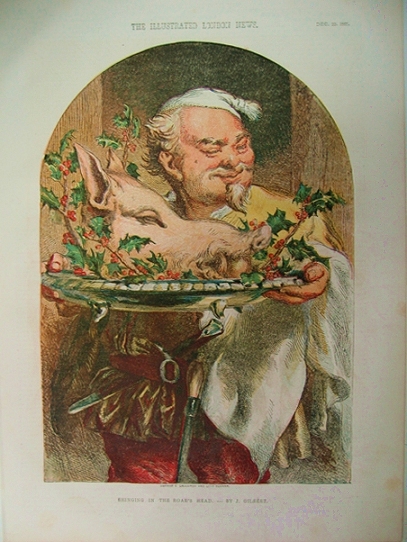
The Boar's Head Festival, from Family Christmas OnlineTMWelcome to a few pages celebrating one of the oldest - and possibly strangest - Christmas traditions that is still in use today. It is an English tradition that resulted from a combination of ancient feasts with Christian traditions.Why the Boar? - Since ancient days, the boar was the most dangerous - and tastiest - game sought by hunters in what we now call Great Britain. When possible, it was the centerpiece of all great feasts, pre-Christian and Christian alike. Why Just the Head? - Unlike a roast pig, which you could carry to the table whole and carve up there, a boar might weigh several hundred pounds and be too big or take too long to cook in one piece. So the boar would be butchered and prepared before the feast, but the head would be decorated and brought in as a tribute to the mighty hunter who had brought it down. The Tradition Becomes "Christian" - The earliest Anglo-Saxons who invaded Britain (and drove out many Christian Celts) had a religion similar to the ancient Vikings, but they were soon followed by Christian missionaries. As Christianity began to change the Anglo-Saxons, the culture of the Anglo-Saxons also began to flavor English Christianity as well. British and English saints began to be added to the church registry, and ancient pagan festivals were often given "Christian meanings" The "Christianized" Boars' Head festival took the tradition of presenting the boar's head to the hunter and turned it sideways - the boar became a symbol for Death, which Jesus "slew" at His resurrection. So the festival honors Christ as the "mightiest hunter of them all." The Queen's College Legend - Tradition traces the most popular version of the "Boar's Head" festival to Queen's College, in Oxford, England. According to legend, a student who was attacked by a boar on Christmas Eve in 1340 overcame the animal by ramming a book of Aristotle down its throat. At the subsequent Christmas-day feast, pork was on the menu. But, in honor of Christmas, the boar's head was presented, not to the hapless scholar, but to the Christ Child whose birth was being celebrated.
Many other traditions and costumes have been added since, including characters from the Christmas story and other medieval Christmas traditions. In a wealthy manor two centuries ago, there may have been a mix of banquet and pageantry that is seldom encountered today. In the most elaborate presentations, a new set of players may have come in with each course. They might be dressed, say as King Wenceslaus and his servant, or as Robin Hood and Maid Marian. There would have followed a skit or a song, then those players would have bowed and exited, or joined the other players to sing along with the ever-growing chorus. Today, to see the big, pageantry verision, you'll probably go to big church or auditorium to enjoy the show without the meal. Or you may attend a "Madrigal Dinner" version. These include a "sit-down" feast but replace some of the pageantry with dialogue, as the Lord and Lady of the feast banter with the jester and any other characters who have been written in. Either way, you will never see the same Boar's Head festival twice. The festival described here is based on several festivals that follow about the same pattern, including the festival presented for many years by the Grace United Methodist Church, in Dayton Ohio. Some of the photos are from Grace United's 2007 Christmas Celebration Page (which has been removed since I first posted this page).
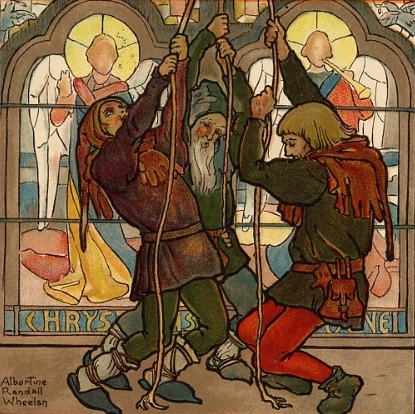
The Festival OpeningPrelude -Usually instrumental and or choral ensembles performing Renaissance-era hymns and Christmas songs.The Opening Bell - A gong or ringing of the church bells sounds the hours.* The Christmas Sprite - A small child representing 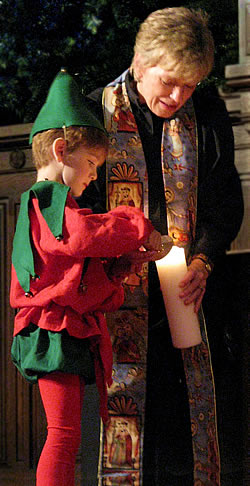 the
spirit of Christmas carries a taper to the altar. An adult (often the
pastor of the church hosting the festival) uses the taper to light the
large Festival Candle and presents it to the congregation. the
spirit of Christmas carries a taper to the altar. An adult (often the
pastor of the church hosting the festival) uses the taper to light the
large Festival Candle and presents it to the congregation.
The Lord and Lady of the Feast - The Lord and Lady of the Manor welcome all present. The Boar's Head is Presented - While the Boar's Head Carol is sung, a company of singers brings in the boar's head and sets it on the altar. Other "steaming" dishes representative of the period are also presented, such as plum puddings and mince pies. The Boar's Head Carol
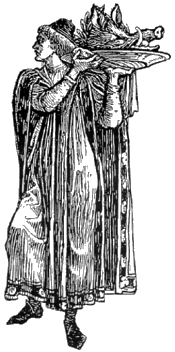 Bedeck'd with bays and rosemary. Bedeck'd with bays and rosemary.
I pray you, my masters, be merry Quot estis in convivio.**
Reddens laudes Domino*** The boar's head, as I understand, Is the rarest dish in all this land, Which thus bedeck'd with a gay garland Let us servire cantico.****
Reddens laudes Domino Our steward hath provided this In honor of the King of Bliss; Which, on this day to be served is In Reginensi atrio.*****
Reddens laudes Domino The mightiest hunter of them all We honor in this festal hall Born of a humble Virgin mild, Heaven's King became a little child:
Reddens laudes Domino 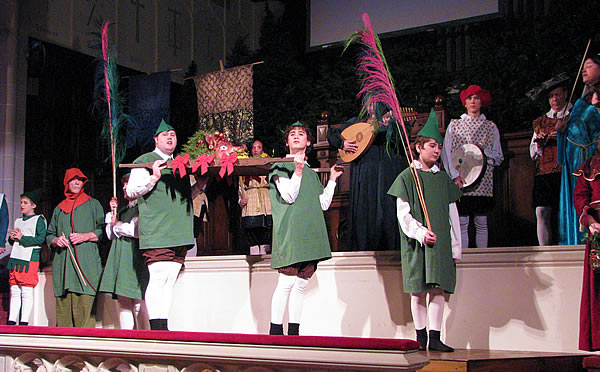 He hunted down through earth and hell He hunted down through earth and hell
That swart boar Death until it fell. This mighty deed for us was done, Therefore sing we in unison:
Reddens laudes Domino Let not this boar's head cause alarm, The huntsman drew his power to harm. So death, which still appears so grim, Has yielded all its power to Him!
Reddens laudes Domino Other PresentationsNow additional celebrations of Christmas cheer are presented, often with congregational songs between each presentation. When one group of presenters is done, they step aside to make room for the next group, but they add their voices to the congregational singing. The additional presentations may include (in almost any sequence):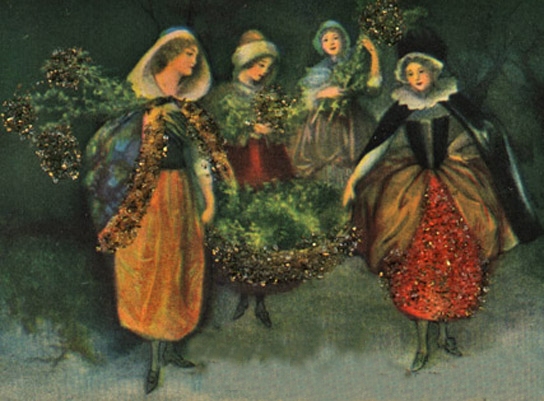 Other Groups in Procession
- Cooks, peasants, lords and ladies, jugglers, church officials, all
dressed in 14th-century English costumes and representing the "high" and
"low" of society. Other Groups in Procession
- Cooks, peasants, lords and ladies, jugglers, church officials, all
dressed in 14th-century English costumes and representing the "high" and
"low" of society.
Good King Wenceslas - The carol "Good King Wenceslas" is sung and acted out. The characters may pantomime, or the King and Page may sing their lines, with the chorus or congregation singing all of the other lines. Carolers - Renaissance-era revelers may lead carols such as "Here We Come a Caroling" The Yule Log - This may come in with the carolers or in a separate presentation. Again, traditional carols such as "The Holly and the Ivy" are sung. If "Deck the Halls" is sung, there may be a symbolic "decoration" of the auditorium, such as a Christmas tree being unveiled, or banners being unfurled. The Shepherds and Magi - The shepherds may lead in singing of "Angels We have Heard on High" and similar songs. The Magi representing Caspar, Melchior, and Balthazar may sing their respective verses to "We Three Kings," while the congregation joins in on the rest of the song. One advantage in placing the Bible characters last is that songs like "O Little Town of Bethlehem" can be used to help transition the ceremony to a time of worship. The Festival Closing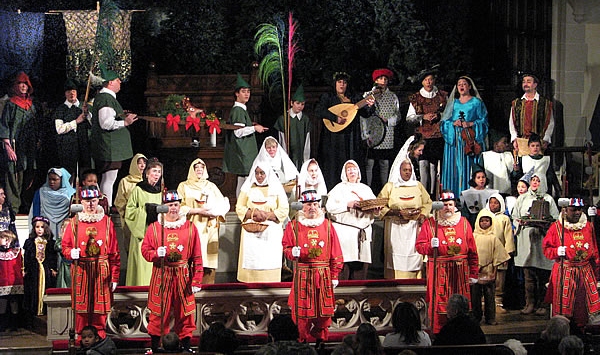 Congregational Worship
- Although there may be congregational singing throughout the ceremony,
many groups close with a congregational song or three. On a song like
"O Come All Ye Faithful," all of the presenters may crowd back to the
front to represent the world coming to Christ. Congregational Worship
- Although there may be congregational singing throughout the ceremony,
many groups close with a congregational song or three. On a song like
"O Come All Ye Faithful," all of the presenters may crowd back to the
front to represent the world coming to Christ.
Recessional - Led by the boars' head, and accompanied by music, the presenters briskly leave the auditorium by the center aisle. Last of all, as the room darkens, the pastor and Christmas Sprite leave, carrying their respective candles. The gong or church bells sound the end of the |