Wednesday, September 23, 2026

Guest blogger Navied Mahdavian on How to fight with the people we care about, illustrated


 WOW! 
Yes WOW!!!!
"Some of my best friends are people who started out as foes."

_ A voice in the Wind


How to fight with the people we care about, illustrated
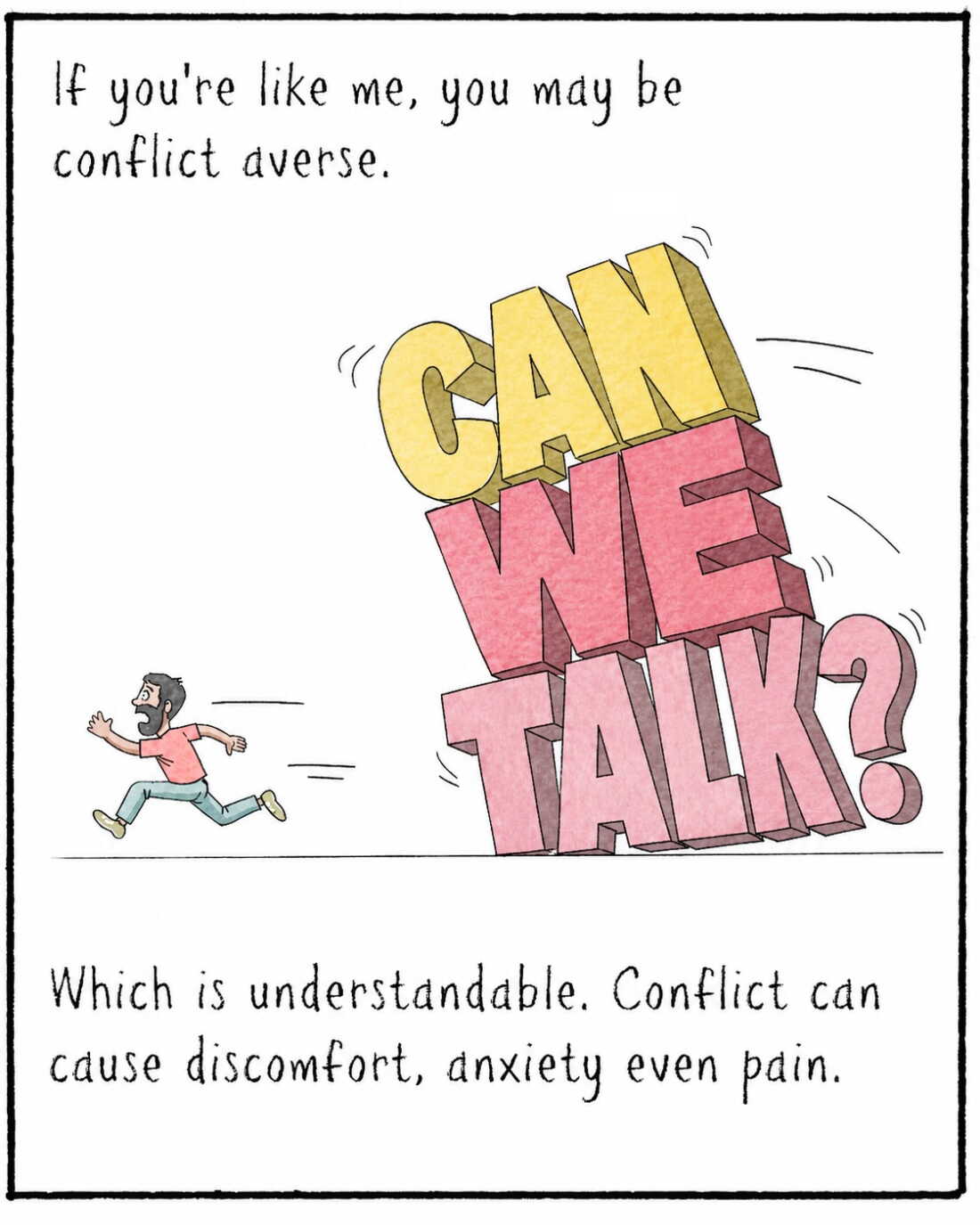
If you’re like me, you may be conflict-averse. 

IMAGE: Navied running away from giant words that are about to fall on him. The words read “CAN WE TALK?”
Navied Mahdavian for NPR

Should we argue with the people we love? For Priya Parker, author of a book published in September, The Art of Fighting: The Transformative Power of Conflict, the answer is yes.

While many people dread conflict, it's not necessarily a bad thing. In fact, it's necessary if we want to be in close, authentic relationships, says Parker. So when you have a moment of misalignment with someone, try thinking of it as a signal. There's something here to talk about.

"We assume if the heat is rising, this must be bad. But the reframe is that there's something relevant here. I should pay attention," she says.

Parker, who has been a conflict resolution facilitator for 20 years, shares advice about common questions you may have about getting into fights — whether that's with a partner, a family member or a friend.
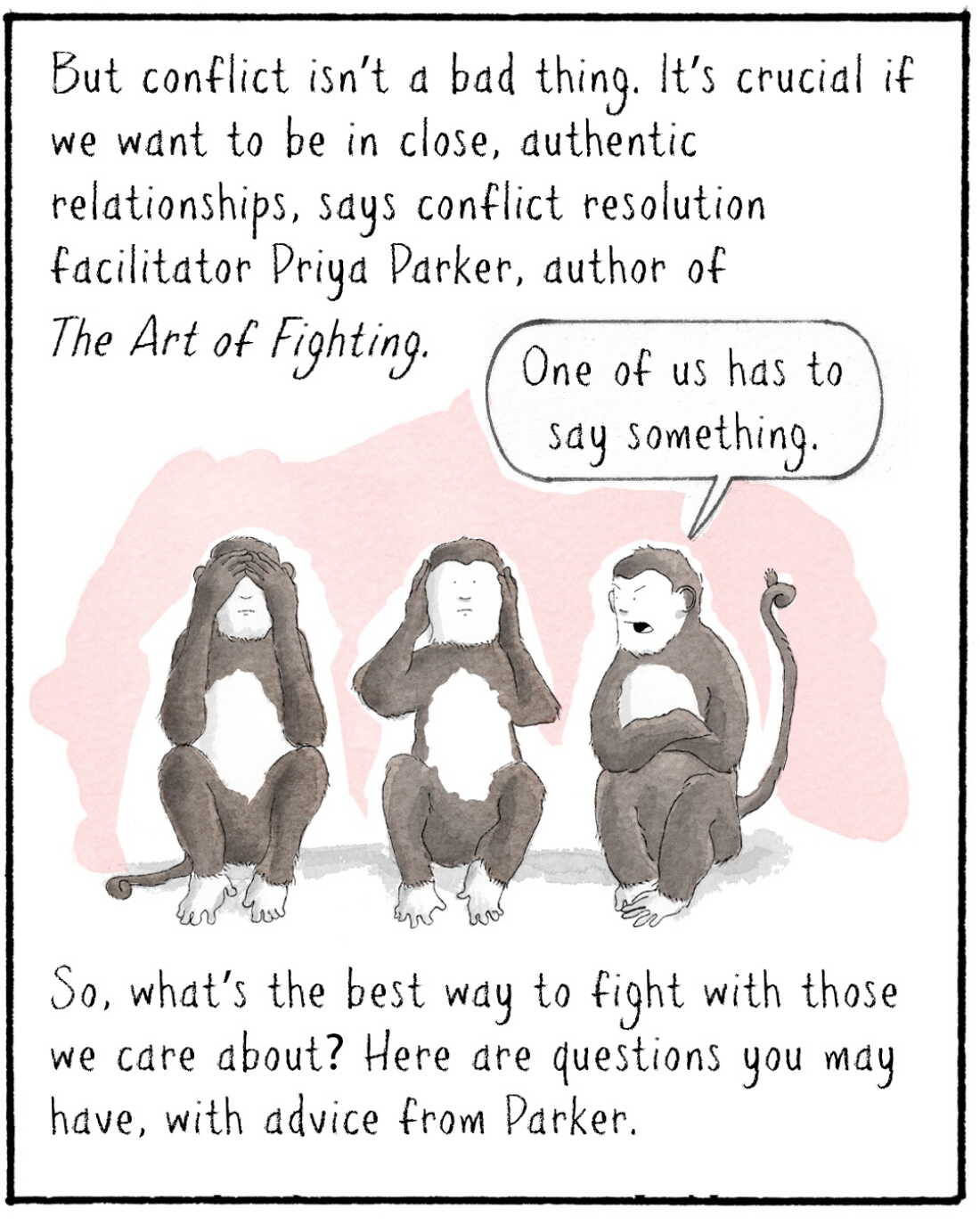
But conflict isn’t a bad thing. It’s crucial if we want to be in close, authentic relationships, says conflict resolution facilitator Priya Parker, author of The Art of Fighting. 

IMAGE: Three monkeys doing the see no evil, hear no evil, speak no evil thing.
MONKEY 3: One of us has to say something.

So, what’s the best way to fight with those we care about? Here are questions you may have, with advice from Parker.
Navied Mahdavian for NPR
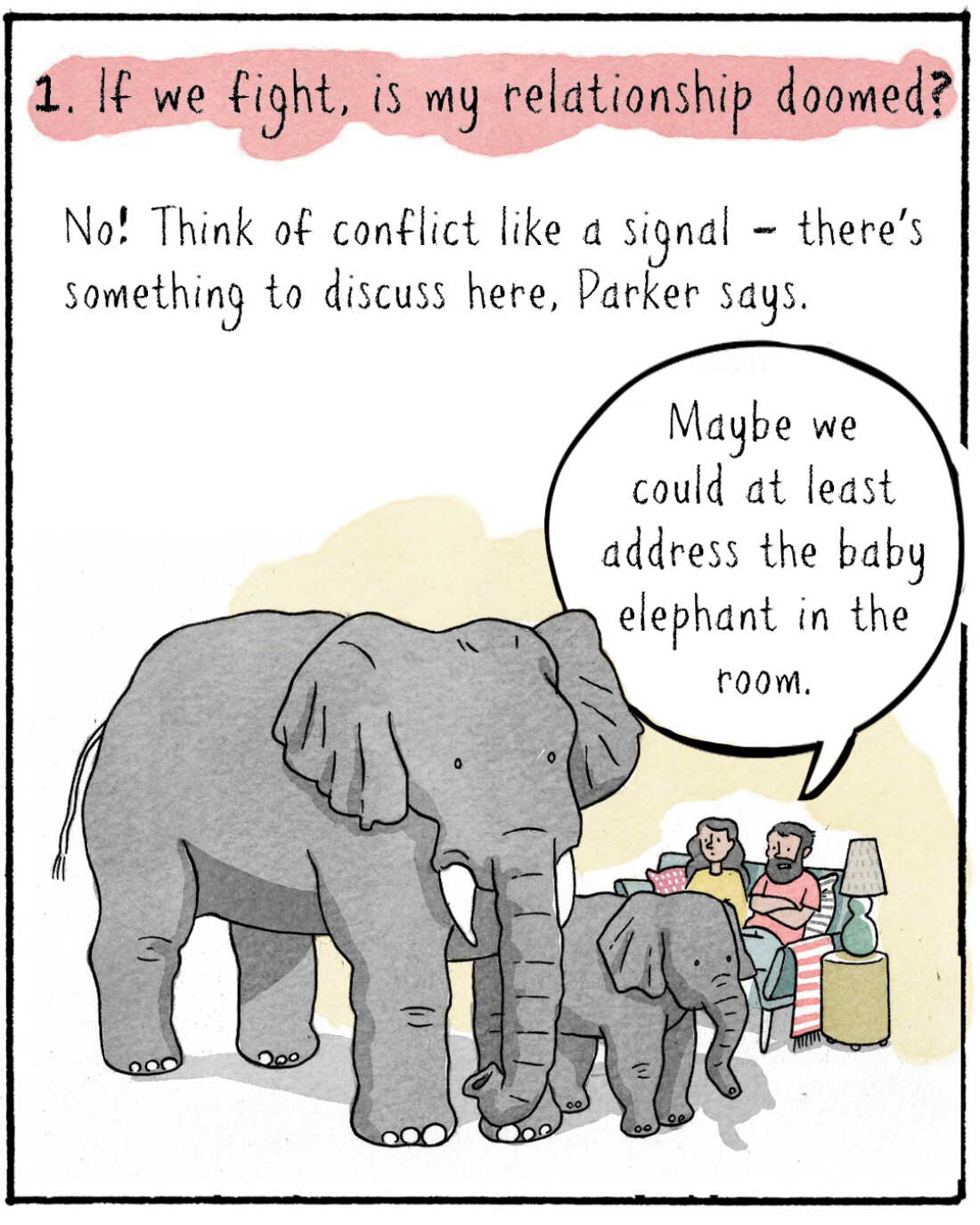
1. If we fight, is my relationship doomed?  No! Think of conflict like a signal – there’s something to discuss here, Parker says.

IMAGE: Navied and a woman sitting on a couch. An elephant and a baby elephant stand awkwardly in the room.
NAVIED: Maybe we could at least address the baby elephant in the room.
Navied Mahdavian for NPR
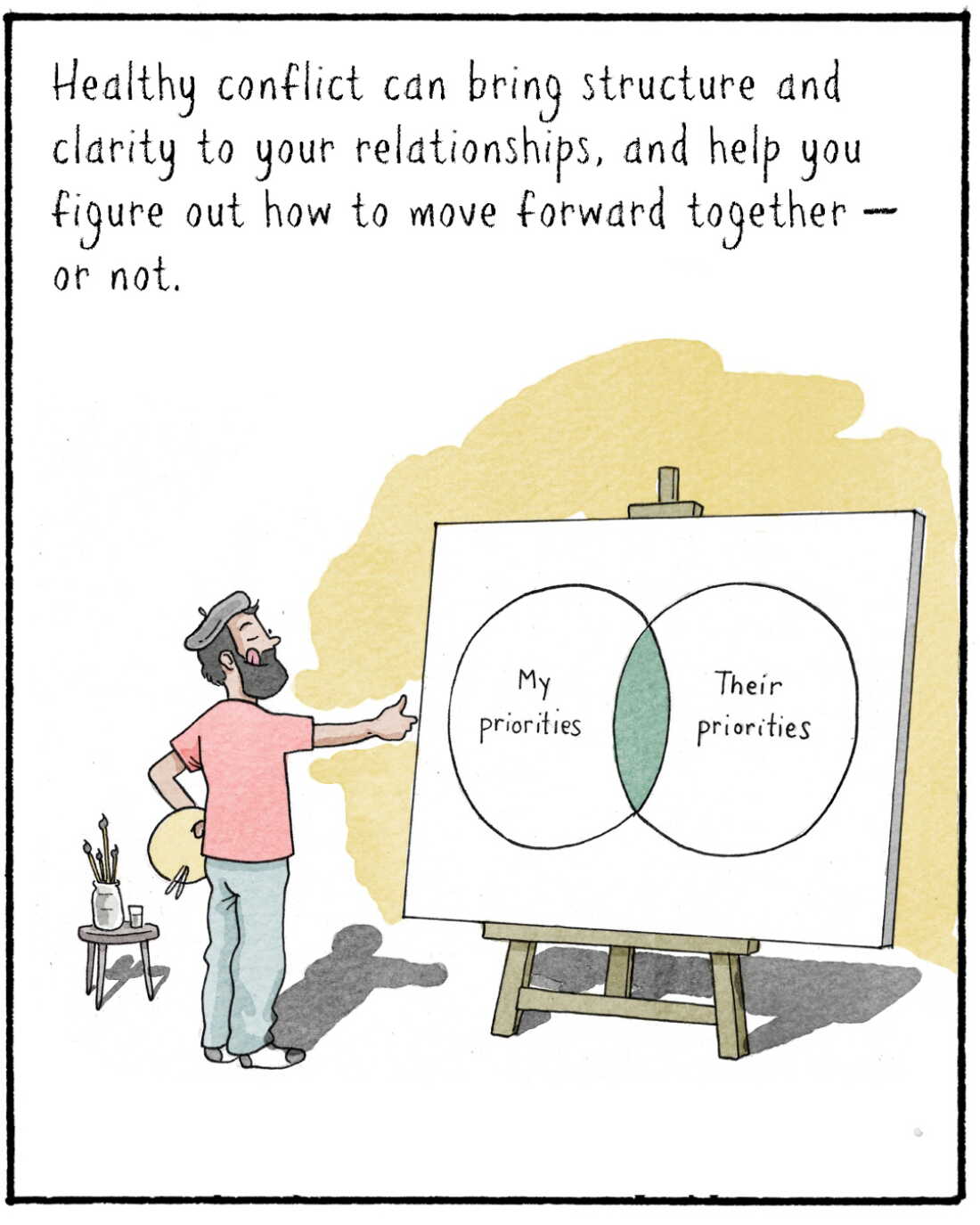
Healthy conflict can bring structure and clarity to your relationships, and help you figure out how to move forward together — or not. 

IMAGE: Navied as an artist standing before a large canvas with a venn diagram painted on it. He holds his thumb out with his eyes closed, as if studying the painting. One side says of the venn diagram says  “My priorities”; the other says “Their priorities.”
Navied Mahdavian for NPR
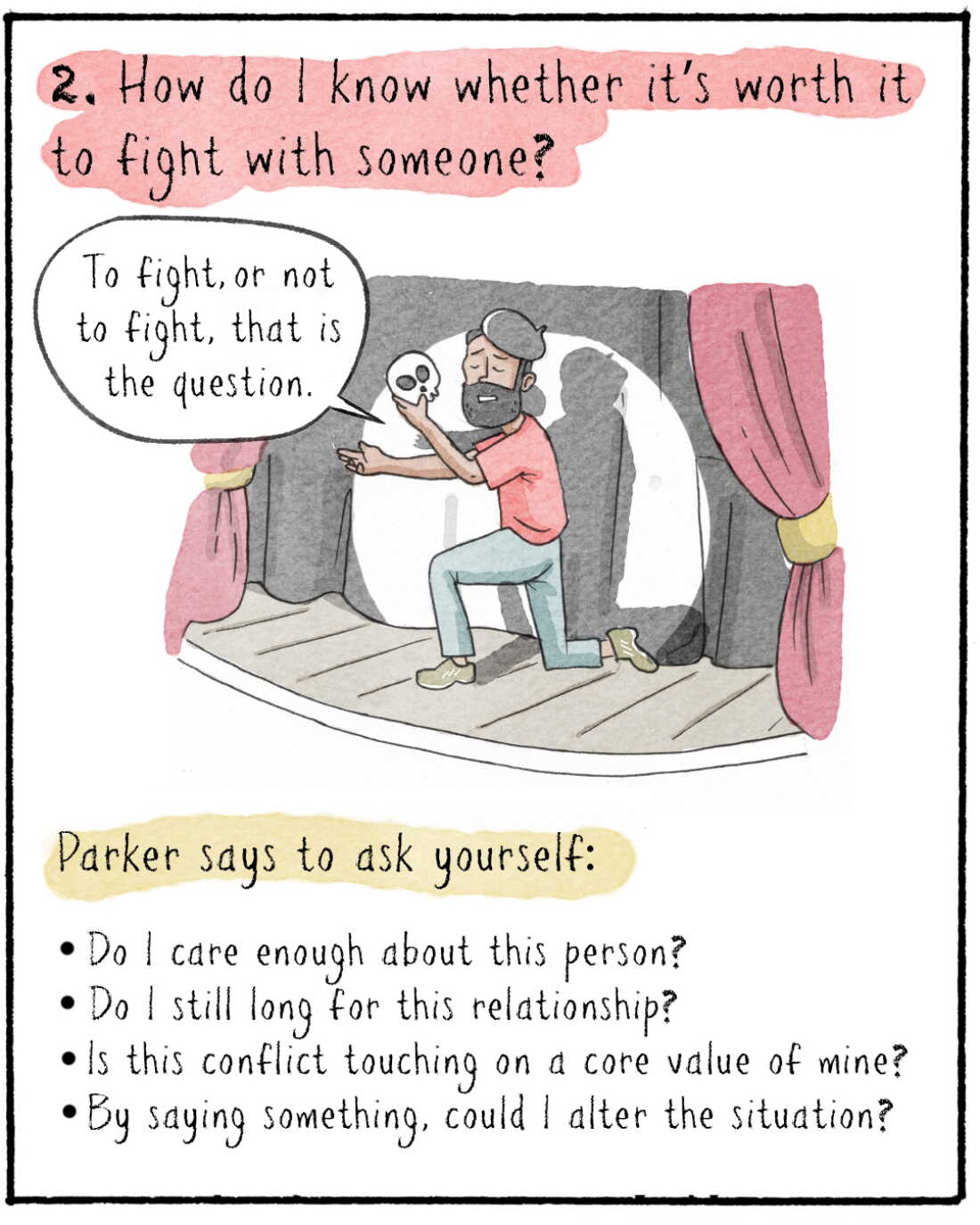
2. How do I know whether it’s worth it to fight with someone? 

IMAGE: Navied on stage as hamlet. 
NAVIED: To fight or not to fight, that is the question. 

Parker says to ask yourself: 

Do I care enough about this person? 
 Do I still long for this relationship?
Is this conflict touching on a core value of mine?
By saying something, could I alter the situation?
Navied Mahdavian for NPR
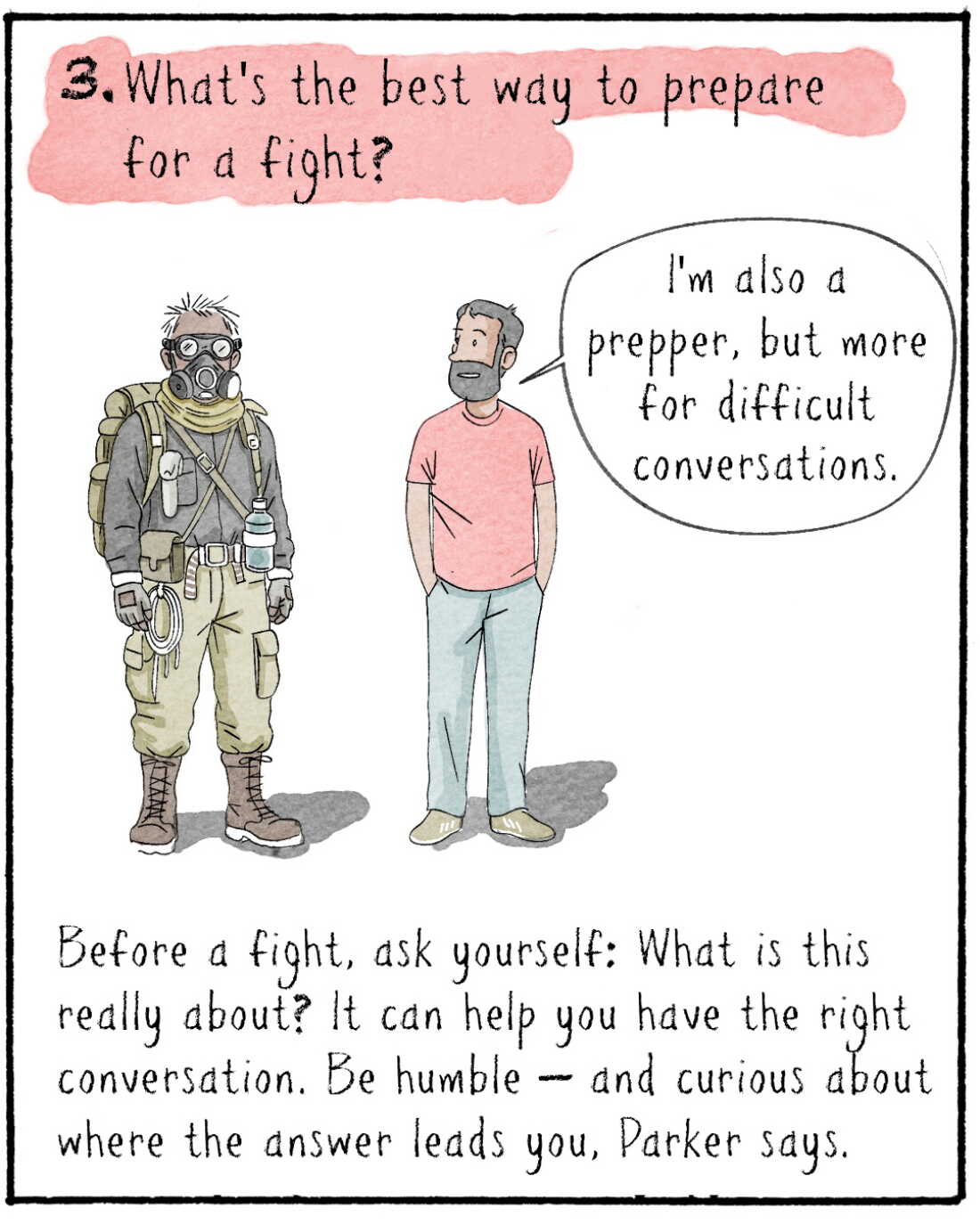
3. What’s the most constructive way to have an argument? 


IMAGE: Navied standing with someone who is dressed for the apocalypse (goggles, combat boots etc.) 
NAVIED: I’m also a prepper, but less for the apocalypse and more for difficult conversations. 

Before a fight, ask yourself: What is this really about? It can help you have the right conversation. Be humble — and curious about where the answer leads you, Parker says.
Navied Mahdavian for NPR
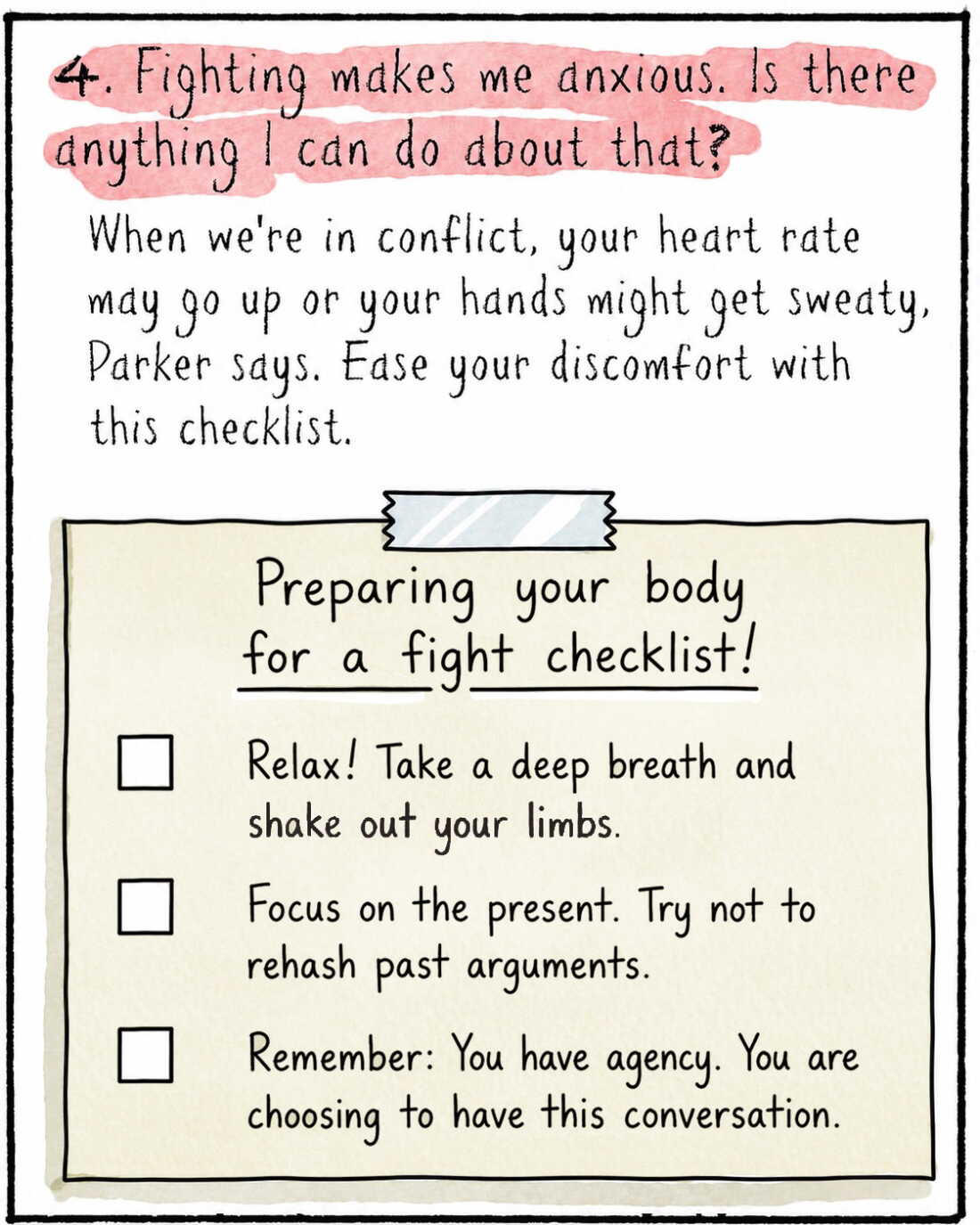
4. Fighting makes me anxious. Is there anything I can do about that? 
Ease your discomfort with this checklist.  

How to get your body ready for a fight

Relax! Take a deep breath and give your limbs a shake. 
 Focus on the present. Try not to rehash past arguments.
 Remember: You have agency. You are choosing to have this conversation.
Navied Mahdavian for NPR
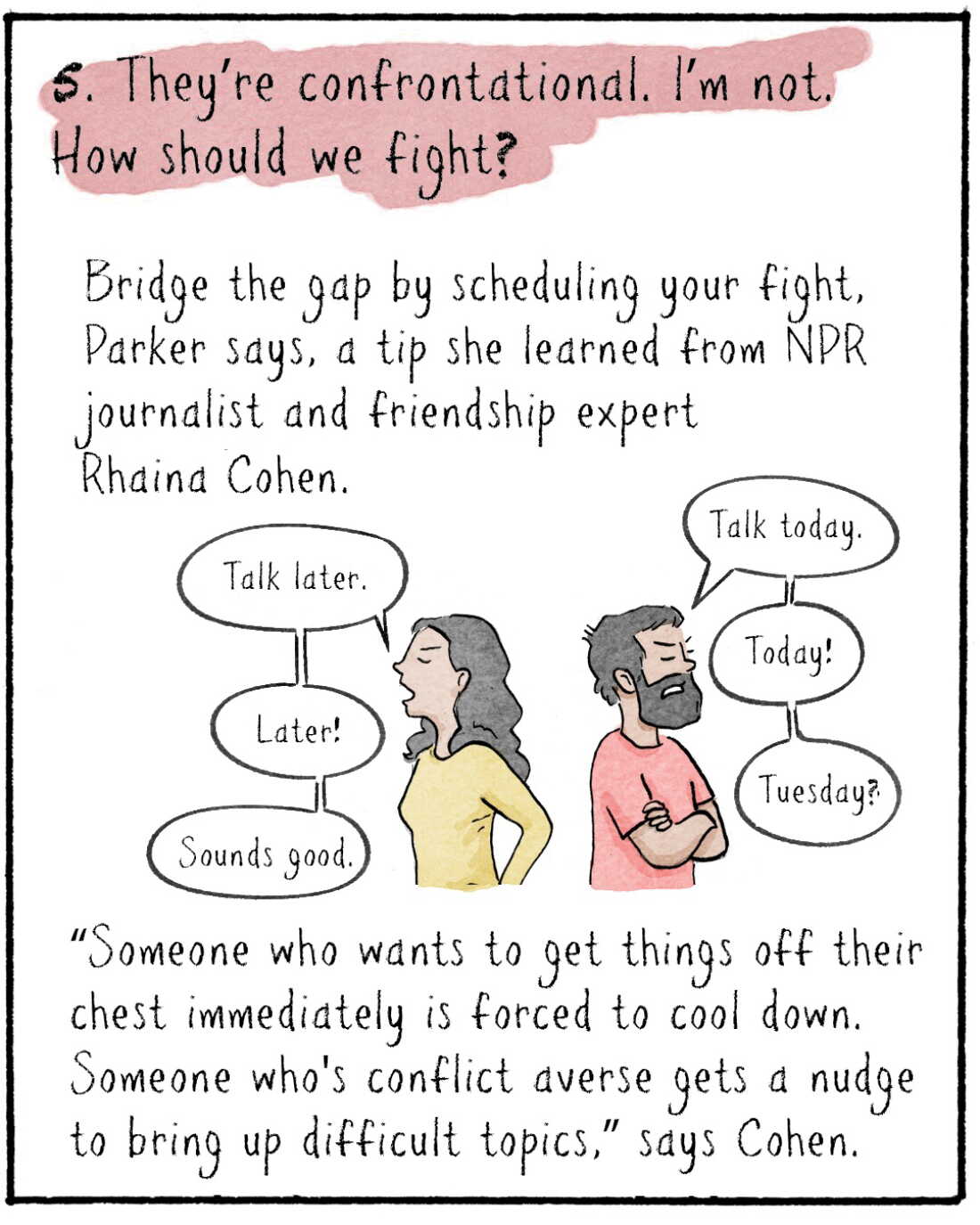
5. They’re confrontational, I’m not. How should we fight? 
Bridge the gap by scheduling your fight, Parker says, a tip she learned from NPR journalist and friendship expert Rhaina Cohen.  

RHAINA: “Someone who wants to get things off their chest immediately is forced to cool down. Someone who's conflict averse gets a nudge to bring up difficult topics,” says Rhaina Cohen.
Navied Mahdavian for NPR
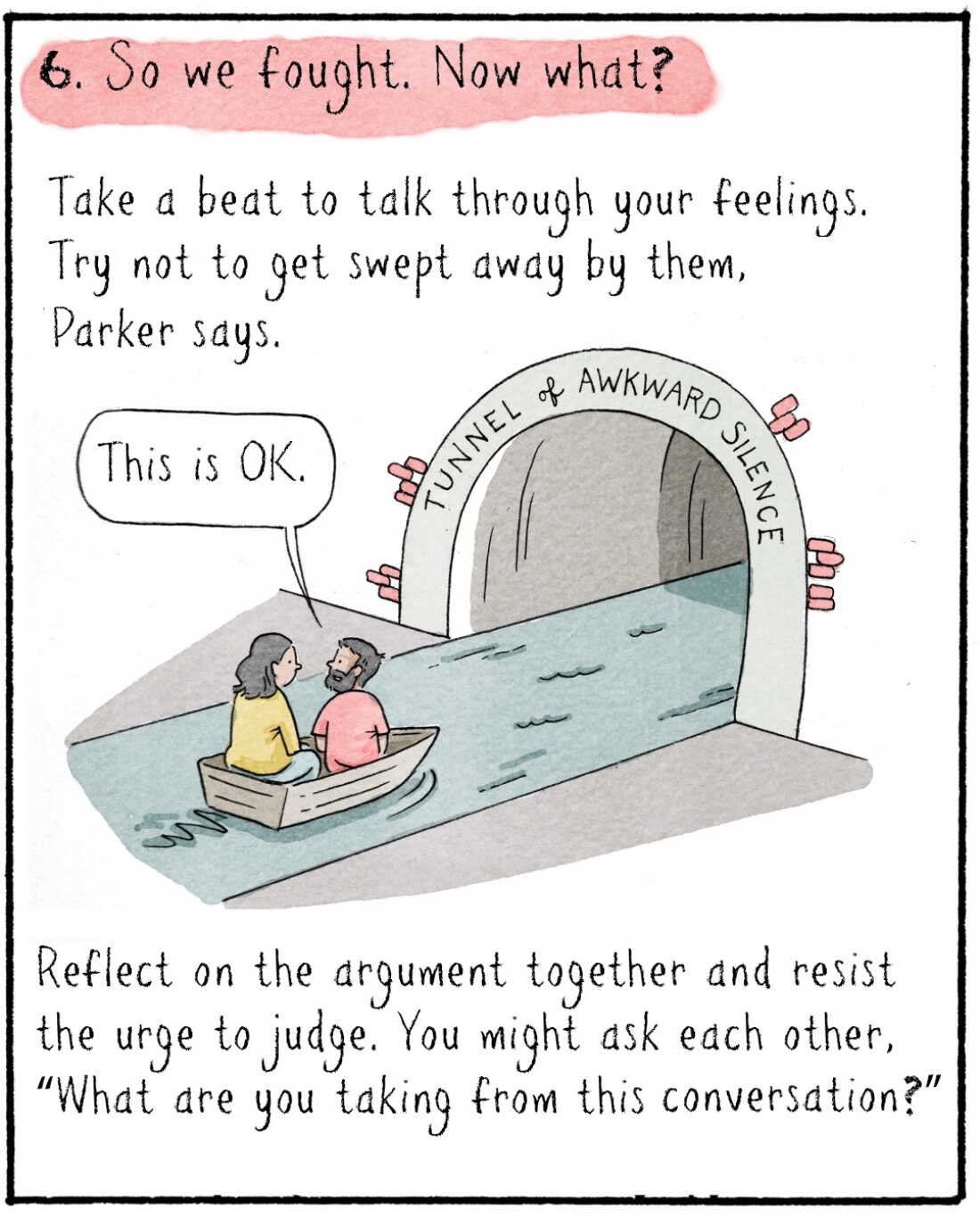
6. So we fought. Now what?  

Take a beat to talk through your feelings. Try not to get swept away by them, Parker says.

	IMAGE: Navied in a little boat with another person. They are about to enter the “Tunnel of Awkward Silence” 
	NAVIED: This is OK. 
	
Reflect on the argument together and resist the urge to judge. You might ask each other, “What are you taking from this conversation?”
Navied Mahdavian for NPR
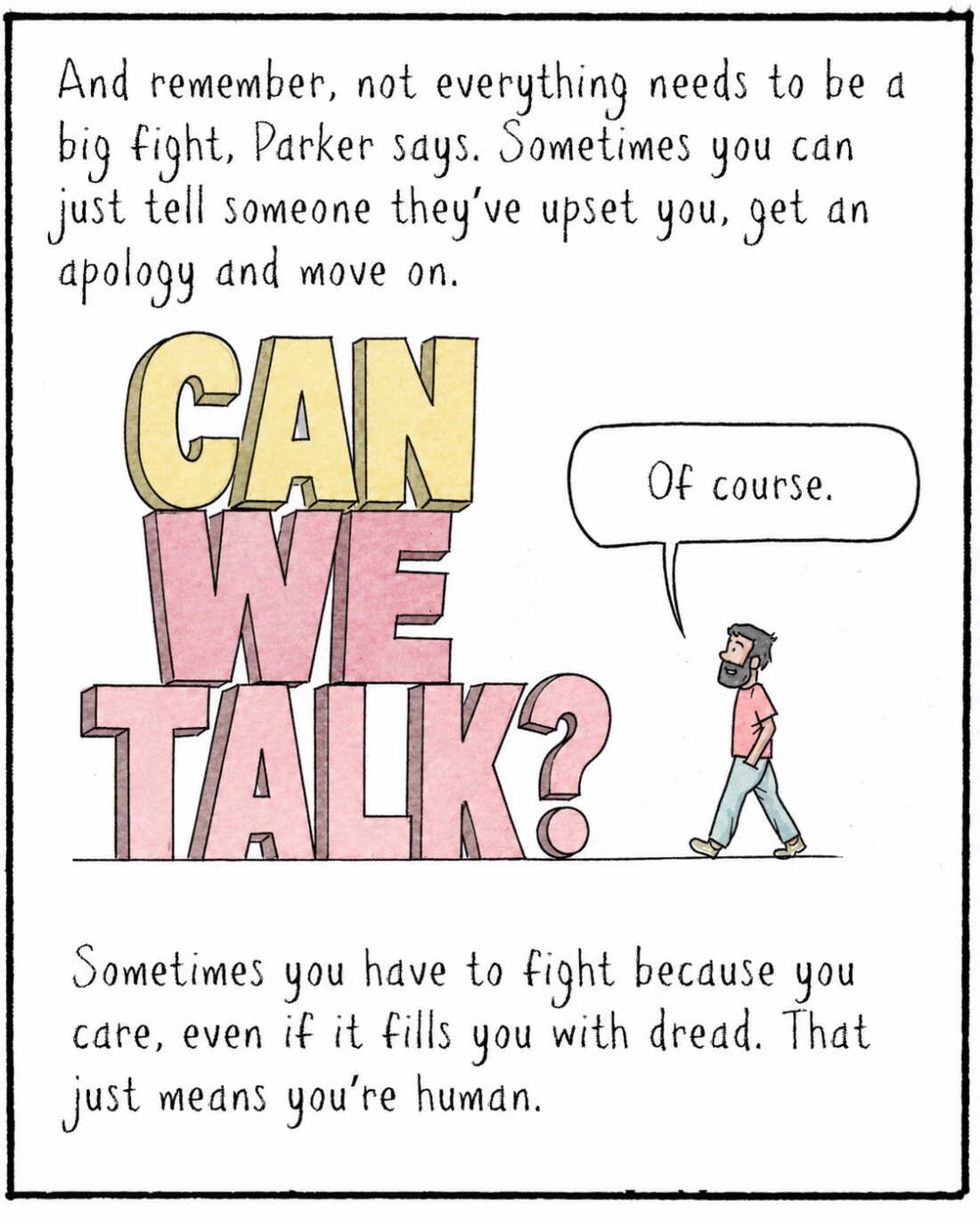
And remember, not everything needs to be a big fight, Parker says. Sometimes you can just tell someone they’ve upset you, get an apology and move on. 

	IMAGE: Navied now walks towards the towering “CAN WE TALK.”
	NAVIED: Of course.   

Sometimes you have to fight because you care, even if it fills you with dread. That just means you’re human.
Navied Mahdavian for NPR

Navied Mahdavian is a New Yorker cartoonist and the author of the graphic memoir This Country: Searching for Home in (Very) Rural America.


Guest blogger Navied Mahdavian on How to fight with the people we care about, illustrated

    WOW!  Yes WOW!!!! "Some of my best friends are people who started out as foes." _ A voice in the Wind         ...