Well OK I forgot the recipes, apologies. Ok , not so much forgot as didn't have time to test them, gotta, just gotta do that first. Ok I just gotta do that because A, I want to know if they are correct/work, and more important I wanna know if they taste as good as they read......and in this case both criteria are met.
The Truth About Peanut Butter Cookies
I haven’t made my mother’s peanut butter cookies for a long time because my grandson is allergic to peanuts. It makes me so sad that so many kids in the younger generations can never enjoy peanut butter cookies and milk–not to mention that staple of school lunches, peanut butter and jelly sandwiches.

After school snack of peanut butter cookies and milk. Harriette Kaser’s china, vintage Daffy Duck glass and Grandma Vera Anderson’s apron*
A recent conversation with my sister, who has very firm ideas about what is and is not allowed in cookies, reminded me not only of oatmeal cookies with raisins, but also peanut butter cookies with crisscross marks on top made by a fork. Where did that particular form come from? After all, you can just put a ball of dough on a cookie sheet and let it spread, or you can press it flat with a glass or the heel of your hand. But fork-made crisscross means peanut butter cookie, doesn’t it? Why?
And are peanut butter cookies a strictly American thing? I don’t imagine that our British and German ancestors had access to peanut butter. And when did peanut butter become such a big deal in the U.S. anyhow?
Peanut Butter History
So, off to do some research. And first thing I found? A website called PeanutButterLovers.com . But of course! Their handy timeline held some surprises, and a couple reasons we Ohioans might particularly be addicted to peanut butter.
- Like many foods that became popular, peanut butter started out as a benefit for health in 1890 when a doctor marketed a peanut butter paste for people with bad teeth. According to another source, he described it as “providing protein for toothless elderly people.” (Wonder how that turned out?)
- At the 1904 St. Louis World’s Fair, peanut butter was sold in a booth and thus introduced to the rest of the world.
- At that point peanut butter was made by boiling in a process patented by Kelloggs in 1895. Now it is roasted for a much better flavor.
- The oldest existing peanut butter company, Krema, was established in COLUMBUS, OHIO in 1908 (two years after my mother was born).
- In 1922 Joseph Rosefield invented a method of churning that resulted in a smoother peanut butter and a shelf-stable product which he sold in California.
- Other early peanut butters were one produced (1928) by Swift and Company (later called Peter Pan), using Rosefield’s methods. Rosefield retaliated by creating Skippy, and produced the first crunch peanut butter in 1930. Jif was a latecomer, first made in 1958, and Jif is now owned by Smucker company of ORRVILLE OHIO.
Although this timeline does not take us into the 2000’s, Peanut Butter has become a trendy food, with small batch peanut butter sold at farmer’s markets and peanut butters in many flavors manufactured by lesser-known brands. You can even grind your own nutbutters at the store in many natural foods markets. (Right beside the coffee bean grinders.)
And more peanut butter is exported from America than any other country. China is the other big exporter.
Peanut Butter Cookie History
More than you ever wanted to know about the history of peanut butter cookies (unless you’re a cooking nerd) appears on the website New England Recipes.
At first, peanut butter cookies were made with ground peanuts instead of peanut butter. George Washington Carver, father of peanuts, published 105 recipes for peanuts that had the first peanut cookies. Then it was discovered that peanut butter could substitute for all or some of the shortening in a recipe.
But cookbooks did not carry the peanut butter cookie recipe we use today until the 1940s. In 1947 the Boston Cookbook School Cookbook finally switched to today’s standard recipe using half brown and half white sugar and equal amounts of shortening and peanut butter.
It appears that Mary Ellis Ames, who worked for Pillsbury, is responsible for our associating fork hash marks with peanut butter cookies, according to the What’s Cooking America website.

- Peanut Butter cookie dough balls

- Crisscross fork pattern on peanut butter cookies.
Peanut Butter Cookie Recipes
You can find numerous variations on peanut butter cookies on the Internet, but for purists, the recipe below is very close to the first recipes published in America for peanut butter cookies.
Since I don’t have a recipe card from mother’s recipe box, I guessed that she used the recipe in the Better Homes and Garden’s Cookbook. But I had one problem. Mother’s cookies were a little soft, and following the recipe from Better Homes and Gardens, I got very crispy cookies. In the notes to the recipe, I address how you can convert the same recipe to get a softer cookie. (Ironically, by reverting to the one measurement where Better Homes differs from the first recipes published.)
I also trampled on tradition with half of my batch of cookies, by melting dipping chocolate and either dipping part of the cookie in the chocolate, or spreading some on top. (My husband think every cookie in the world is improved with chocolate, and the chocolate lovers of the world must be served.)

Contemporary Chocolate dipped peanut butter cookies with tea
Let me know where you stand on peanut butter cookies. Crispy or soft? With additions or not? Do your have crisscross fork marks?
ONE MORE TIP: Mother always put a slice of apple or a piece of bread in the cookie jar to keep the cookies soft. And by golly, a piece of bread even made my crispy cookies nice and soft!
Family Favorite: Peanut Butter Cookies
 Print recipe
Ingredients
- 1 cup shortening (softened but not liquid)
- 1 cup white sugar
- 1 cup brown sugar
- 1 teaspoon vanilla
- 2 eggs (beaten)
- 1 cup peanut butter (smooth or crunchy)
- 2 1/2 cups sifted flour ((see note))
- 2 teaspoons baking soda
- dash salt
Optional
- 2 cups Dipping chocolate wafers
Directions
Note
The original recipe, calling for 3 cups of flour, and baking at 375 degrees for ten minutes, resulted in a very crispy cookie.
If you prefer a softer cookie, use my recipe, which reduces the flour by 1/2 cup and the baking temperature to 350 instead of 375.
In either case, remove the cookies while they are still slightly soft on top, as they burn on the bottom quite easily, and will finish baking, even on a cooling rack.
If you store the dough "log" in the refrigerator before baking, it may take as much as an hour at room temperature to soften enough to slice and bake.
If you choose to use the chocolate coating, consider storing the finished cookies in an airtight container in the refrigerator, particularly in summer.
*A note about the family heirlooms in the first picture can be found in my next post.

Peanut Butter Oatmeal Chocolate Chip Cookie Bars
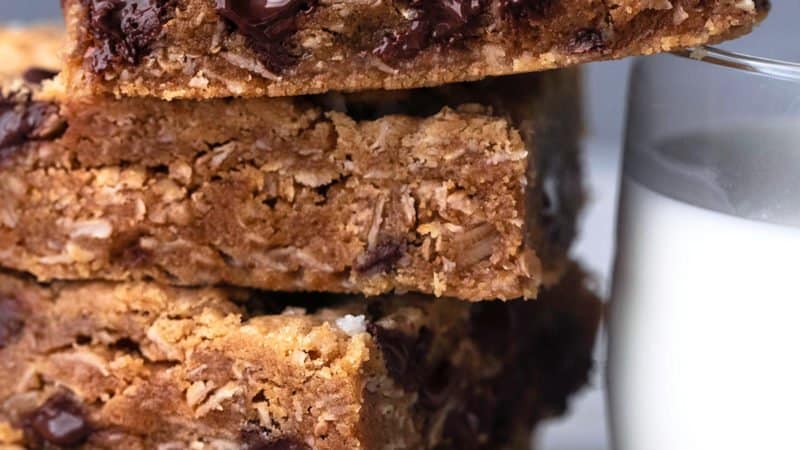
Ingredients
- 1 cup butter, softened
- 1 cup sugar
- 1 cup brown sugar
- 1 cup creamy peanut butter
- 2 eggs
- 1 tablespoon vanilla extract
- 2 cups flour
- 2 cups old fashioned rolled oats
- ⅔ cup shredded coconut flakes
- ½ teaspoon salt
- ½ teaspoon baking soda
- 2 cups semisweet chocolate chips
- 1 teaspoon coarse sea salt
Instructions
- Preheat oven to 350 degrees and line a 9x13 inch pan with foil or parchment.
- In a large bowl cream together butter and sugars for about 2 minutes until light and fluffy.
- Add peanut butter, eggs, and vanilla and mix well.
- In a second bowl whisk together flour, oats, coconut flakes, salt, and baking soda.
- Add dry ingredients to wet ingredients and mix until combined.
- Stir in chocolate chips.
- Press into an even layer in prepared pan.
- Bake for 20-25 minutes. Remove from oven and immediately sprinkle sea salt over the tops of the bars.
- Allow to cool completely before cutting into bars and serving. Store in airtight container at room temperature.
Notes
Nutrition

